Something fun for the blog, today! A Fictionalised Account from the Diary of a Young Apprentice, by Megan Kelleher. Megan completed a placement with us as part of her MA in International Heritage Management at the University of Birmingham. She researched the lives of the people shown in the portraits of the historic boardroom where the BMA was founded, and created this lovely piece of creative writing. Enjoy!
It’s no more than a ten-minute walk to the Cathedral from Mr Tipton’s apothecary.
The last shipment has just been packed away so when Russell and his wife call to ask if Tipton will deign to join them for the bishop’s speech. It’s the 18th of October, the Feast of St. Luke the Evangelist, and a Friday at that. Mr Tipton speaks a little more with Mr Russell, then calls me out from behind the counter. It’s been decided; we’re off to church.
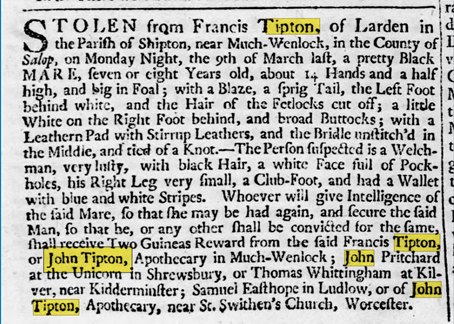
I fetch my hat, and Mr Tipton’s quick to scold me on the state of my cravat. It’s redone without much fuss, and we set out, Russell and Tipton walking just a little ahead discussing the matter of a stolen horse from Much-Wenlock. The mare wasn’t more than seven or eight years old and is yet to be returned to some relative of Mr Tipton who bought the horse not two years previously. Not one visitor to our little apothecary at St Swithen’s takes his leave without hearing the tale, but Mrs Russell seems to have, until now, escaped the minutiae, for she asks if the police have not even a suspect.
‘My dear Mrs Russell,’ my master assures her, ‘I am quite certain if you were on the case the mare would be munching on the pastures of Much-Wenlock as we speak! You see a suspect was described! Yes, yes, quite soon after the event. Francis told me himself, a rather distinctive fellow at that. A Welshman, yes, dark hair, face full of pock holes, and here’s the kicker my dear, one leg considerably smaller than the other! Well, I said to him, quite plainly, just as you and I are talking now, I said Francis how many men of that profile could there possibly be?’
Mr Russell leans in to murmur something in Mr Tipton’s ear, too quiet for either Mrs Russell or me to hear, that sends Tipton laughing quite heartily.
Mrs Russell is very new to her title, having married Mr Russell earlier in the year. She’s a young woman of twenty, in a smart brown dress and neat hat. Mr Russell turns to his wife as we approach the cloisters and calls her Anne. Anne Russell, née Chettle, practically Worcestershire gentry Mr Tipton had told me when he had gone to sign the marriage bond.
Dr John Wall, a man of forty years with a long, straight nose, and arched brow, meets us halfway up the pews and grasps Mr Russell’s hand in a genial manner.
‘Russell, good man, nice to see you. Yes, and I see you’ve brought your wife. Charmed, charmed. Wonderful weather we’re having for October is it not?’
We all agreed that the weather was unseasonably acceptable.
‘You managed to wrestle the entire household out today I see’ Russell observes, looking over Dr Wall’s shoulder towards a sizeable party surrounding a tall woman with powdered hair, and four young children.
‘Just about, just about.’ The doctor agrees, looking back towards his family, then slightly further to where the bishop is arranging his notes. His voice lowers, ‘terrible business with Maddox’s daughter.’
‘Very unpleasant,’ Russell agrees.
‘What was that then?’ Tipton asks both men – he has been remarkedly restrained on entering the Cathedral but seemed unable to hold his tongue much longer.
‘Died, just under a year ago now.’ Russell says.
‘Only eleven too.’ The doctor adds with an uncharacteristically solemn air.
‘Oh, how awful! Does he have many children?’ Mrs Russell asks, her eyes scanning for Lady Maddox.
‘Just two. Ah yes, I can see Isaac frolicking at the front there.’
We all turn to watch the boy, who cannot have been more than eight years old hurry about with a certain freedom of the limb that characterises the overenergetic child. The show is shortly brought to a close, an arm beckoning the boy back to his seat as Bishop Maddox ascends the pulpit.
Dr Wall claps Russell on the arm a final time, offers a small bow to Mrs Russell, and a nod towards Mr Tipton before retreating towards his pew. We shuffle into our own places, me, then Tipton, then the surgeon, and his wife who has barely time to wrangle her skirts into an orderly fashion before the Bishop of Worcester begins his speech.
‘Let us not be weary in well-doing, for in due Season we shall reap, if we faint not’ Maddox begins, ‘as we have therefore Opportunity, let us do Good unto all Men, especially unto them who are of the Household of Faith.’
He strikes me as an extraordinarily well-read man, his manner is engaging, his sentiments admirable, but it is Friday, our pew is a little too far back to be noted, and the bishop’s heavy stack of notes appear to suggest that Maddox has only just begun. That is to say, when Mr Tipton chuckles quietly next to me in response to some comment from Russell, I find myself straining to hear the surgeon’s next observation.
Both men are quiet for a while, in which time there is much adjusting to try and find the angle of best comfort in these harshly designed pews, but when Maddox exclaims – with a new burst of enthusiasm – ‘But see all these gloomy Clouds dispelled, and cheerful Day-Light broke in upon this dark and melancholy Scene; joyful Health succeeding painful sickness; and in the Place of dreadful Anguish, perfect Ease!’ Mr Russell shuffles quite pointedly where he sits and asks Tipton, ‘Is the ease in the room with us?’
It is only when the question of medicine is articulated by our loquacious speaker, however, when the surgeon’s mood appears to sour. He grumbles most heartily to his neighbour about quacks, and old women, and possessors of charms, and the place of medicine itself in the delicate art of healing.
‘Medicines unskilfully administered but with an Expense very heavy to their distressed Condition,’ the bishop describes, with enthusiastic sympathy, ‘Creatures oppressed with Pain and Want, languishing separately in their own dismal Cottages!’
‘It appears our good languishing people manage to find quacks to double their distress and empty their pockets not a mile beyond the infirmary’s walls.’ Mr Russell pointed out rather seriously to his neighbour Mr Tipton, who hummed as if he had heard the surgeon say a similar thing several times before.
The bishop’s speech draws to a close with a reminder as to the congregation’s own frail mortality. ‘In a few Years, possibly in a very few Days, your Body will be laid upon a sick Bed, your Head upon a dying Pillow – pause a little and consider yourself in this tremendous Condition.’
I confess I became rather overwhelmed by the prospect and, half unsure, half eager to affect the surgeon (whose cool humour had impressed me greatly) I thumped my head back sharply against the pew as if imagining I was quite abruptly upon that very sick bed.
I thought I might have seen his lip twitch.
At the very least I mustn’t have offended him greatly, for as we stood, he offered me a little advice. ‘Now, if you ever do find yourself an incurable patient so suddenly upon your death bed, I suggest you call all the quacks in the land.’ I looked up at him, wondering if this was the same man who had muttered against quacks not moments before. ‘Only John,’ the surgeon continued, with an air of mischief, ‘Promise them no money until they have cured you; and then send them to me, and I will cheerfully pay them.’
Context: see below, a news article about the stolen horse.