Amanda Kanina is an undergraduate history student at the University of Worcester.
Science Museum Group. Do not poison the air he breathes. 1999-241/54 Science Museum Group Collection Online. Accessed 31 March 2026. https://collection.sciencemuseumgroup.org.uk/objects/co8179397/do-not-poison-the-air-he-breathes.
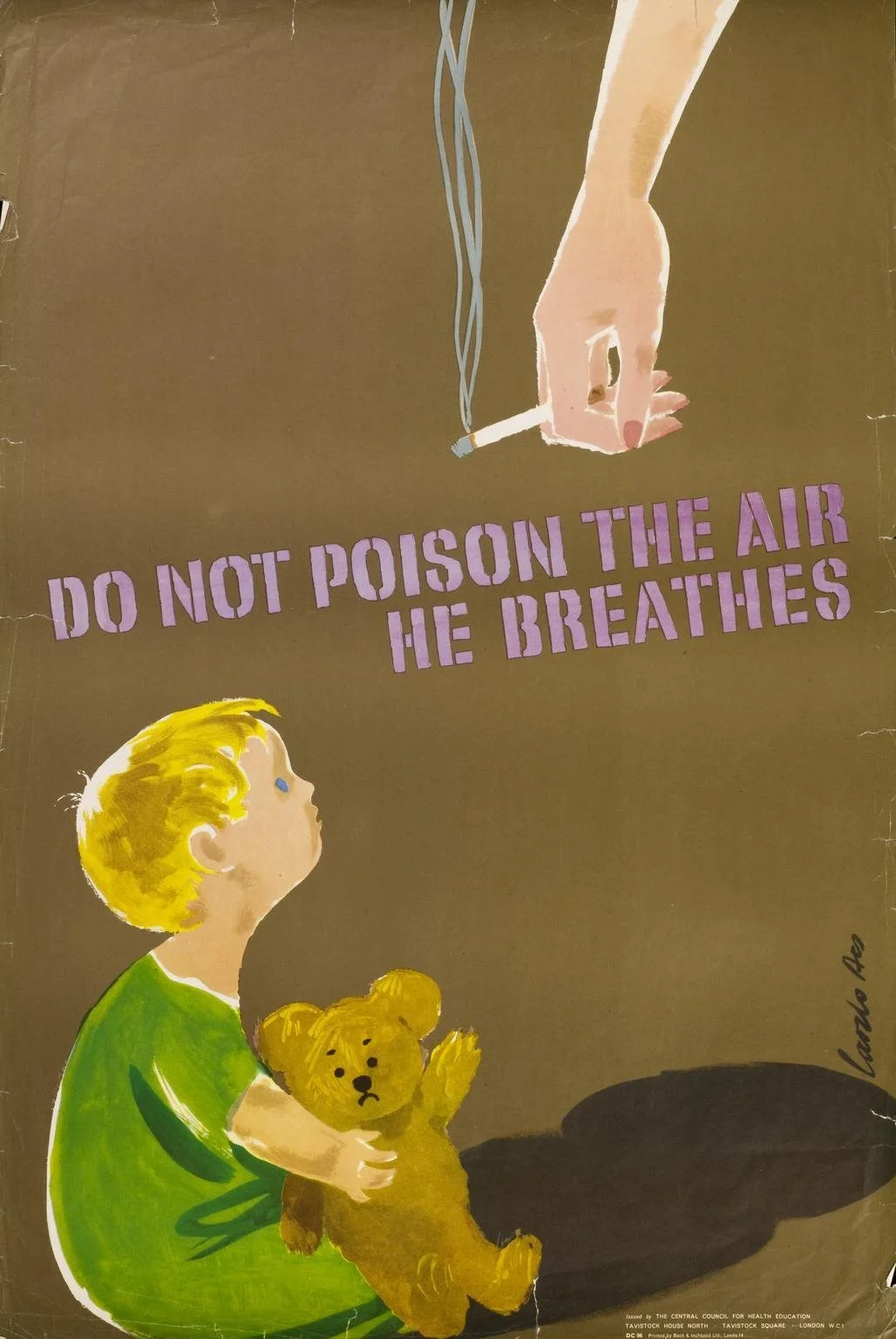
By the 1950s smoking was as a deeply embedded cultural habit for men and women of all classes, one that was even initially marketed for health to reduce stress.[1] Tobacco was considered an economic rather than a health issue, so what triggered the later campaigns against smoking?[2] The connection between smoking and lung cancer was the turning point that brought the concern from infectious to chronic diseases, resulting in new lifestyle-orientated public health campaigns.[3] As a result, the 1960s ‘do not poison the air he breathes’ poster frames second-hand smoke as an act of harm, serving as an early example of the new ‘healthism’ ideology that shifted the responsibility of health onto the individual.[4] In this case, it is the parent’s responsibility to protect the child’s health. Additionally, as it is a woman’s hand holding the cigarette, it frames mothers as the primary carers of children, reinforcing traditional gender roles.
By the 1960s the establishment of the National Health Service shifted smoking from a private habit to a public problem, as the state assumed responsibility for the cost of health treatment. In this context, the poster’s significance lies in its emphasis on prevention of illnesses, symbolising “a new era of health risk”.[5] It was issued under the Central Council for Health Education, marking the government’s growing role in health education.[6] The Council worked closely with Local Authorities, which suggests that it would have been distributed through local government networks in places such as schools, hospitals, clinics and community spaces to educate the public about the risks of smoking.[7] However, since mothers were among the primary attendees at clinics, the poster’s intended and actual audience were most likely women.
Even though over the twentieth century smoking was established as a feminine practice, it still remained “overwhelmingly a male habit”, which makes it significant that the poster paints the mother, not the father, as the one endangering the child.[8] Firstly, it reinforces that women’s smoking was seen as a central public health “problem”.[9] Secondly, it conveys the contemporary thought that the raising of young children was a woman’s primary occupation.[10] However, while it stresses the classic ‘women as mothers’ role to control female smoking, it is a male baby that needs to be protected.[11] As historian Virginia Berridge points out, women were often the focus of health campaigns, “but there was no doubt that the at-risk fetus was male”.[12] The gender of the child and the smoker therefore reflect contemporary ideals of men as the future of the nation while women as its guardians. In addition, the poster portrays the child as the one needing protection from the ‘poisonous’ cigarette smoke, and that reflects the 1960s growing concern about infant mortality.[13] For example, Gareth Millward shows that from the 1940s campaigns were initiated to immunise all school children, which means vaccination also demonstrated the broader aim to protect children’s health.[14]
Ultimately, the issue of smoking marked the redefinition of public health around lifestyle issues, and the anti-smoking poster played a role in conveying that idea.[15] However, it stigmatised female smokers more harshly than male smokers, thus painting women as the agents of health and reasserting traditional gender expectations around maternal responsibilities.[16] While from the first glance the policy changes around smoking might seem straightforward, in reality they reflected the social ideals of 1960s Britain.
References
[1] Rosemary Elliot, ‘'Everybody Did It'-or Did They?: The Use of Oral History in Researching Women's Experiences of Smoking in Britain, 1930-1970’, Women's History Review, 15.2 (2006), pp. 297–322, (pp. 317-318); Virginia Berridge, ‘The Policy Response to the Smoking and Lung Cancer Connection in the 1950s and 1960s', The Historical Journal [THJ], 49.4 (2006), pp. 1185–1209, (p. 1999).
[2] John Singleton, 'Going Up in Smoke: Tobacco and Government Policy in the Age of Austerity, 1945–50', Twentieth Century British History, 34.4 (2023), pp. 681–702, (p. 681).
[3] Virginia Berridge, 'Postwar Smoking Policy in the UK and the Redefinition of Public Health', Twentieth Century British History [TCBH], 14.1 (2003), pp. 61-82, (p. 61); Gareth Millward, Vaccinating Britain: Mass Vaccination and the Public since the Second World War (Manchester University Press, 2019), p. 10.
[4] Virginia Berridge and Kelly Loughlin, ‘Smoking and the New Health Education in Britain 1950s-1970s’, American Journal of Public Health [AJPH], 95.6 (2005), pp. 956–964, (p. 956).
[5] Berridge, ‘The Policy Response to the Smoking and Lung Cancer Connection in the 1950s and 1960s', THJ, (2006), p. 1208.
[6] Berridge and Loughlin, ‘Smoking and the New Health Education in Britain 1950s-1970s’, AJPH, (2005), pp. 956-959.
[7] Administrative background, ‘Central Council for Health Education: Minutes and Papers’, The National Archives, n.d. <https://discovery.nationalarchives.gov.uk/details/r/C10925> [accessed 27 December 2025].
[8] Penny Tinkler, ‘Refinement and Respectable Consumption: the Acceptable Face of Women's Smoking in Britain, 1918-1970’, Gender & History, 15.2 (2003), pp. 342–360, (p. 349); Virginia Berridge, ‘Constructing Women and Smoking as a Public Health Problem in Britain 1950-1990s’, Gender & History [G&H], 13.2 (2001), pp. 328–348.331, (p. 344).
[9] Berridge, ‘Constructing Women and Smoking as a Public Health Problem in Britain 1950-1990s’, G&H, (2001), p. 328.
[10] Sarah Crook, Unhappy Mothers: Women, Motherhood and Social Change in Postwar Britain (Manchester University Press, 2025), p. 16.
[11] Berridge and Loughlin, ‘Smoking and the New Health Education in Britain 1950s-1970s’, AJPH, (2005), p. 963.
[12] Ibid., p. 961.
[13] Berridge, ‘Constructing Women and Smoking as a Public Health Problem in Britain 1950-1990s’, G&H, (2001), p. 333.
[14] Millward, Vaccinating Britain: Mass Vaccination and the Public since the Second World War (2019), p. 34.
[15] Berridge, 'Postwar Smoking Policy in the UK and the Redefinition of Public Health', TCBH, (2003), p. 81.
[16] Berridge, ‘Constructing Women and Smoking as a Public Health Problem in Britain 1950-1990s’, G&H, (2001), pp. 331, 344; Crook, Unhappy Mothers (2025), p. 15.