AKA ‘The House of Industry’, ‘Tallow House’, ‘The Union’ (vulgarly “The Grubber”), ‘Shrub Hill Infirmary’ and ‘Hillborough’
From Elizabethan times, individual parishes had been responsible for the care of their poor and destitute and in Worcester there had been a small workhouse on the site of the present Hop Market Hotel at the top of Sansome Street, but this had failed to be a success and had been closed down before the middle of the 18th century. In 1794, The House of Industry was built at the top of Tallow Hill, then just outside Worcester, with George Byfield of London as the architect and as his name implies was intended to be more than just a replacement of the old workhouse. It was supposed to accommodate 150 men, women and children, but within two years of opening there were 223 inmates as recorded.
The new building consisted of a Central Block and two wings. The Central Block contained a dining room, a director’s room, school room and workrooms with bedrooms on an upper storey for both men and women, and some rooms for married couples. The North Wing contained the kitchen, bakehouse, dairy, laundry and apartments for employees, and the South Wing had accommodation for those too old to work, and also facilities for washing and de-lousing new admissions, a bathroom, W.C.’s and brewhouse (as beer was drunk instead of tea) and a reservoir for water. There was also a garden, a farmyard and a burial place. Children were given the rudiments of education in the school rooms and the main products from the workrooms were woollen cloth and gloves. The Institution was under the control of wardens appointed by the parishes and there was a Chaplain, a Governor and a Matron.
In only a few years, the good intentions of this type of House of Industry failed to be maintained and the buildings degenerated into being a workhouse for paupers and the destitute. The 1834 Poor Law Act allowed parishes to unite together to provide for their poor and as a result of this much money was saved. The building at Tallow Hill came to be known in the City as “The Union”, a name dreaded by the elderly poor in need of care, and as late as the 1930s possible admission to The Union was talked about as ‘having to go up the hill’. This same Act of Parliament in 1834 required that parishes appoint Guardians of the Poor, and The Union thus came under this Board of Guardians.
Until the time of Florence Nightingale after the Crimean War (roughly about 1860–65), there were no real nurses and anyone sick in the Union was just looked after by the other inmates and later by untrained attendants both male and female.
In 1893, there must have been considerable rebuilding as there is a foundation stone indicating that it was laid in 1893 by Miss Bellers, daughter of the Chairman of the Board of Guardians. This stone was relocated and set in the wall at the corner of Hill Street and Byfield Rise (named after the original designer of the House of Industry). The Institution continued into the 20th century as a typical Victorian-type workhouse with its regular old, poor and destitute inmates. In addition, it served as accommodation for vagrants who could be seen waiting nightly at a side gate opposite Shrub Hill Railway Station for admission, a meal and a night’s lodging for which they had to do a prescribed amount of manual work next day before being allowed to leave.
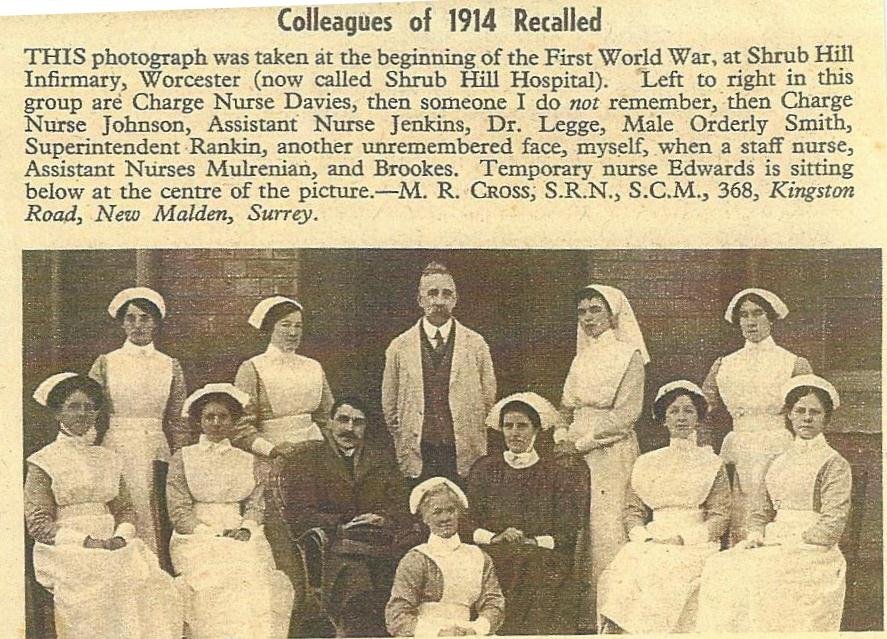
Apparently taken of at the beginning of the First World War.
This state of affairs continued until the end of the 1920s when the Board of Guardians was dissolved and the City Council took over the Institution and converted part of the building into a municipal Hospital under the City Medical Officer of Health with a staff of properly trained and trainee nurses, the latter spending some time at Castle Street Infirmary before sitting the final examinations for State Registration. The Patients were looked after by an assistant M.O.H. and a consultant surgeon was appointed to deal with surgical work. There were proper hospital wards and a small operation theatre unit was set up. To allay any stigma which might still exist, the hospital was known as Shrub Hill Infirmary and the rest of the buildings were still used to house the indigent poor. Hopes for development of this as an active general hospital failed to materialise, and in the main the admissions to the hospital beds were transfers from the other parts of the building being inmates who became ill and requiring of hospital treatment.
Then in 1939 came World War II. The whole hospital was closed down and the chronic inmates transferred to similar accommodation at Avonside Hospital, Evesham. The vacated buildings were taken over by the Royal Air Force as a top level administrative establishment for the duration of the war.
War over, the RAF vacated the buildings and with the advent of the National Health Service in 1948 the buildings again took on their former use partly as Shrub Hill Infirmary and partly as an old person’s home known as Hillborough. The hospital section was administered and staffed at W.R.I. at Castle Street and used largely as an overflow from Castle Street or for chronic sick in need of hospitalisation, and Hillborough came under control of Social Services and Welfare. Also for a few years the General Practitioner Maternity Unit was housed at Shrub Hill until this was transferred to Ronkswood Hospital as part of the Maternity Unit there by the 1970s (if you gave birth at this unit, please let us know!).

Dr. W. Steel describes a development in the local maternity service, 1977. Clipping from the museum’s collection.
During the last several years of its existence, Shrub Hill Infirmary became a Geriatric Unit with a consultant Geriatrician and assistant medical staff, and with the opening of Phase 1 of the new District Hospital at Newtown, the whole of the Shrub Hill complex was closed down in the early 1980s, and the buildings demolished in 1987 leaving only the Nurses Home which was transformed into living flats and the administrative block which used in connection with Youth Training. The remainder of the vacated area including the surrounding grounds was built over as a housing site.