OUTSIDE THE ASYLUM
Can you help George Marshall Medical Museum with a spot of family history research to find out about some people who were admitted to the Worcester City and County Lunatic Asylum in the 19th century?
Our aim is to share more patients’ stories, and to find out about their lives before admission and (where possible) after discharge.
William walford
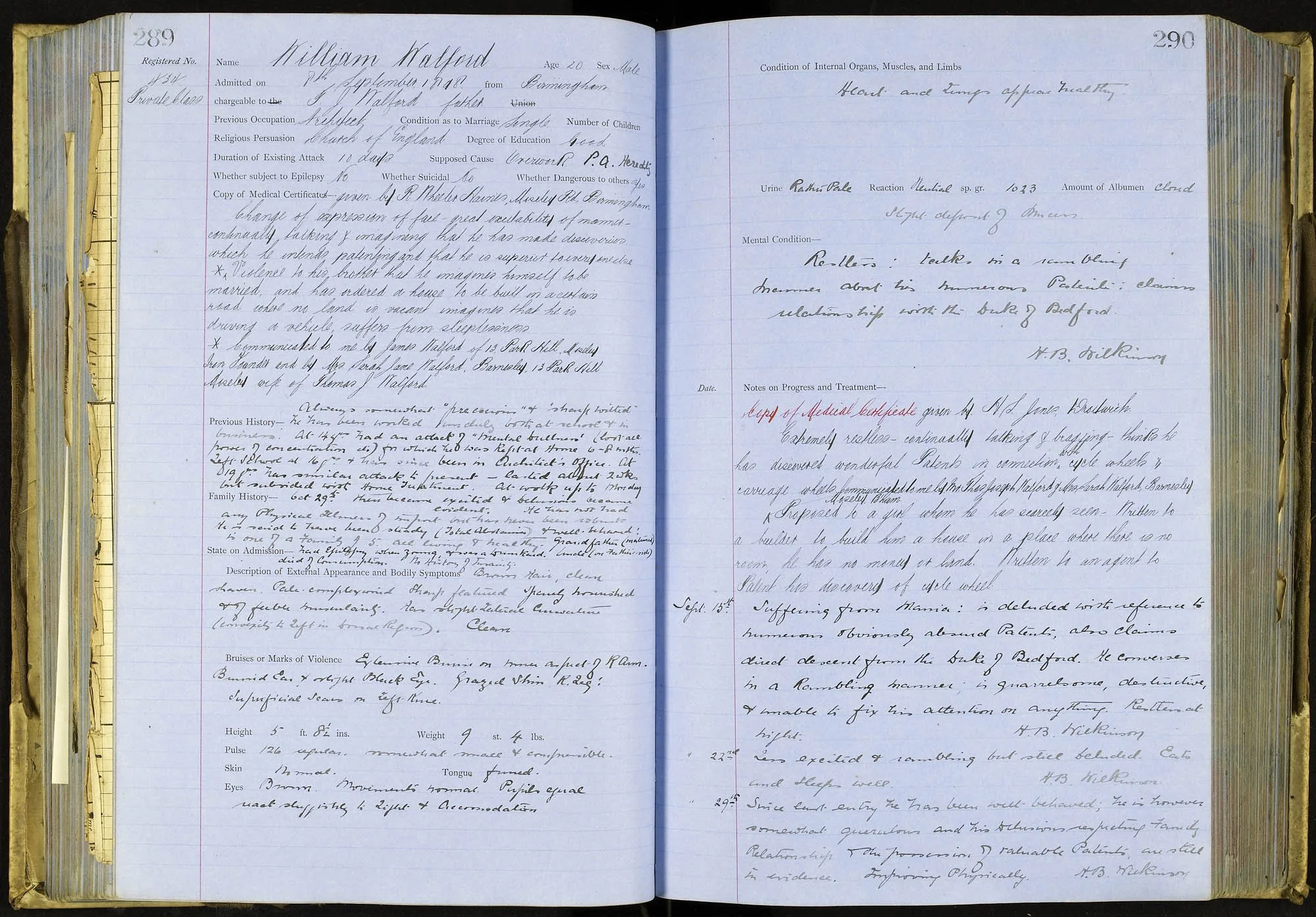
find out more about william walford
William Walford (not Halford, as named on Powick website pages) was born in late 1877, the second son of Thomas J Walford and Sarah J Russell. The family were well off, earning their money from an iron foundry in Birmingham, which specialised in making fenders. They lived in Moseley, near Birmingham, in a spacious house and employed two or three servants. When William was born, the family lived in Trafalgar Road but later moved to a new house at 13 Park Hill.
William was sent away to school, as was the custom for wealthy families. His medical history shows he had his first attack of “mental fullness” at the age of 14, and was thus home from school for 6-8 months. He left school at 16 and suffered a second attack aged 19 which lasted for two weeks, he did not have to be hospitalised on that occasion but was treated at home. At the time of his admission to Powick, during his third attack, he had been working in an Architect’s office as a clerk. He was diagnosed with Mania, due to “overwork and/or heredity” although his records show no history of ‘insanity’ in the family. William was brought to Powick by his brother James and his mother on 9 September 1898 as a private patient.
William’s medical history describes him as “precocious” and “sharp-witted” and although not “robust” had never suffered any major illness. Prior to admission, his family reported that he thought he had invented useful inventions relating to a bicycle wheel or carriage wheels and he intended to patent them. He also ordered a house to be built in a place where it was not possible, and thought he was married. At Powick he was restless and sometimes suspicious and violent towards other people if he thought they were talking about him in a derogative manner. At times he thought he was the Prince of Wales, and at others related to the Duke of Bedford. Eventually he recovered to the point where he admitted his delusions were a mistake, and was discharged after about nine months.
William went on to live his life. In 1907 he married Irene Blanche Brooks Benison, the daughter of another wealthy merchant family. Her father was a solicitor and Irene’s brothers were involved with tea and rubber plantations in Ceylon (now Sri Lanka.) They went on to have one daughter and two sons and lived in 43 Grove Avenue. After discharge from the asylum in 1899 William worked as a clerk in his father’s factory, the Atlas iron foundry in Charles Henry Street in Digbeth, Birmingham. His older brother James, who originally took him to Powick, enlisted and fought in the Second Boer War. He was listed as missing, presumed dead, on 25 February 1902 at the battle of Yzer Spruit. His father died in 1904 and by 1911 William was the foundry manager. The 1927 Electoral Register for Deritend Ward (the factory location) shows that from 1927 a Phillip Wilmott Grice also had a stake in the business. Phillip and his wife Minnie were old neighbours of the Walfords and lived next door to them at 41 Grove Avenue for several years.
By the time of the 1939 census William is retired through ill health, his wife is listed as the foundry manager and his daughter secretary to her mother. He died in 1947 in Llandudno, North Wales.
Research by Helen Rendell, 2025.
To view William’s patient records, click here.
Go back to find out about more people who were patients at the asylum.