OUTSIDE THE ASYLUM
Can you help George Marshall Medical Museum with a spot of family history research to find out about some people who were admitted to the Worcester City and County Lunatic Asylum in the 19th century?
Our aim is to share more patients’ stories, and to find out about their lives before admission and (where possible) after discharge.
william henry gray
find out more about william henry gray
William Henry Gray was born in April 1852 in Worcester. He was the third child to John and Agnes Gray. His twin brothers George and John were born, 2 years earlier. Sadly George died aged whilst Agnes was pregnant with William. A sister, Agnes was born in 1854.
His parents had married on the 10th of January, 1849 in Hoxton London. On the wedding certificate John’s father was stated as a gentleman and Agnes’s father was Minister. Her grandfather was the Reverend Samuel Lyndell, a well-known Non-conformist minister in London. After they married they settled in the All Saints area of Worcester and John’s profession on the 1851 census was stated as Hosier.
In 1861, the family Gray are living at 2 different addresses, John, Agnes and daughter Agnes were living together in the High Street, Worcester and the boys John and William, were living at Comer House, which appears to be a private school, with 10 pupils and 2 headmistresses.
In 1871 the census, puts them all back together at a new home, in Britannia Square, Worcester with Head of family, John as Hosier Principle, employing 3 assistants besides members of the family, John, aged 20 and William aged 19 and Agnes as Hosier assistants.
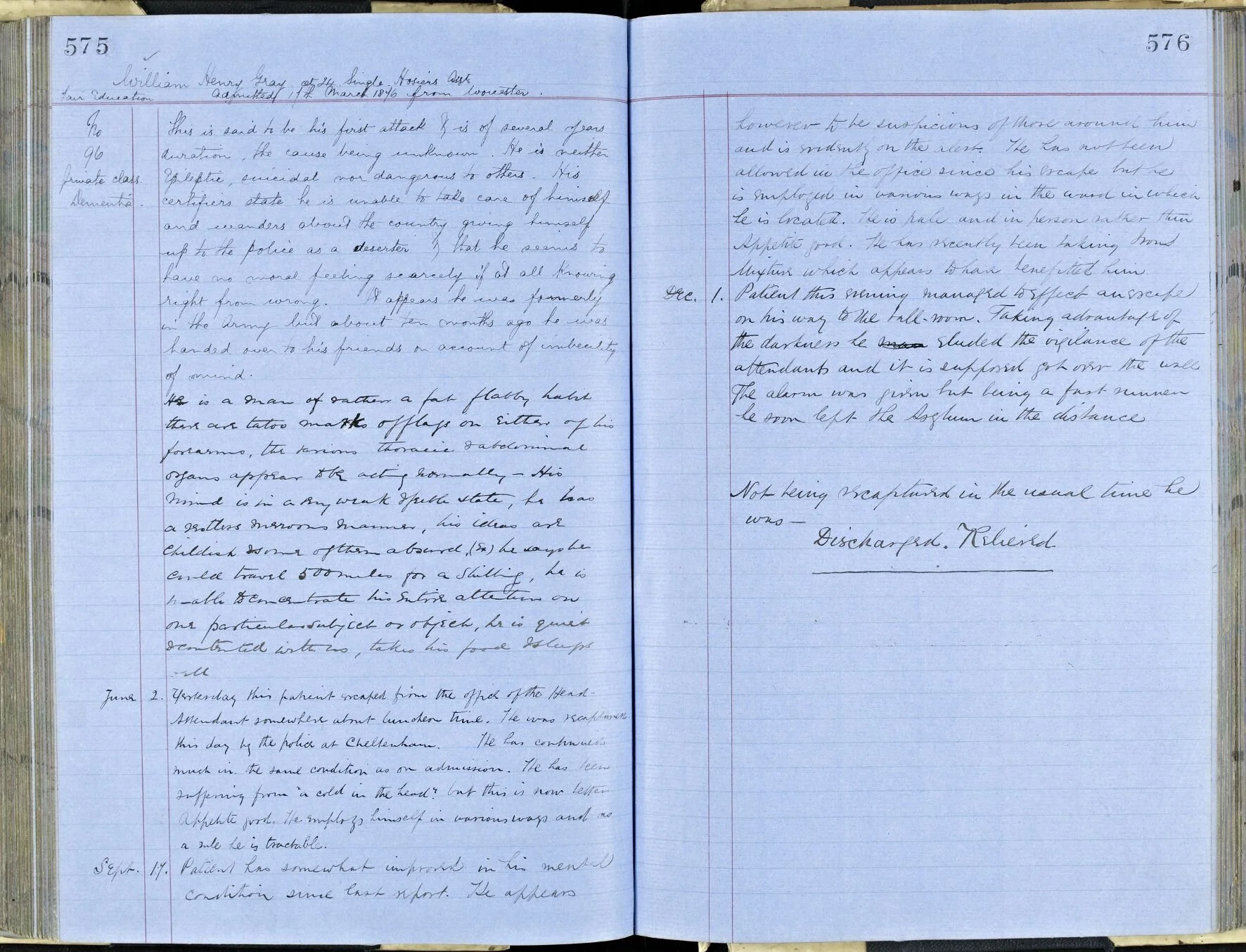
The first time William is admitted to the Worcester City and County Asylum was on the 17th March 1876, William was described as 24 years old, single, his profession was Hosiers Assistant, he had a fair education and was of Private class with a diagnosis of Dementia. This was thought to be ‘his first attack’ but ‘of several years duration’. He did not have epilepsy or thought to be suicidal or dangerous.
The medical certificate stated that he was unable to care for himself, he wanders the county, giving himself up to the Police as a deserter and that he has ‘scarcely any moral feeling and barely knows right from wrong’. It says that he had been in the Army about 10 months prior to admission but was ‘handed over to his friends on account of imbecility of mind’. It was also observed that he had a fat, flabby habit and tattoo marks of flags on both forearms. His ideas are childish and often absurd. A few days later, he is described as ‘his mind being of a weak and feeble manner, with a morose manner and unable to concentrate on any one thing. The next record in June 1876, notes that ‘he had escaped from the office of the head attendant at luncheon time’. He was ‘recaptured’ the same day and returned to the hospital, complaining of a ‘cold in the head’. In September 1876 he ‘was somewhat improved’ though ‘still suspicious and constantly on the alert’. The record makes note that he had not been returned to duties in the office, but ‘proved useful on ward duties’. He was recorded as taking the ‘Stroud mixture’ which seems to have benefitted him. He obviously had, as on December the 1st 1876 ‘he effected an escape whilst on his way to the Ballroom, taking advantage of the darkness, he eluded the vigilance of the attendants and it was thought he went over the wall. The alarm was sounded but being a fast runner, he soon left the Asylum in the distance’. As he was not found in the usual time, he was discharged relieved.
The next entry that can be found for William Henry is that he is admitted to the Northampton Asylum on the 28/9/1877. This would fit with his return to the Worcester City and County asylum on May 19th, 1902. William’s admission notes at this time state that he was admitted from St. Andrews Asylum, Northampton and it was likely he had been there for the last 20years. The diagnosis was Dementia of 26years duration.
His father, brother and sister continued to live in Worcester and appeared to have had a successful Drapers business on the High Street. His mother Agnes, had disappeared from the censuses in the 1860’s and was described by her husband as intemperate.
The copy of the medical certificate on admission, states that he claimed ‘he was as miserable as possible, reflecting on the murders he had committed’. His Father, John and a Mrs Vernall (visitor to family home) informed the admitting officer, that he was ‘perpetually in distress. A further discussion with his Father and sister Agnes state that ‘he stands in the corners of rooms, he says he has murdered a great many people and he is not fit to live’.
Sadly subsequent notes record him as having a ‘dull vacant expression’ and ‘having little idea of time or place’. Notes made on an infrequent basis, state that he appears very depressed, very demented and by September 1911, the orderly’s state ‘he will sit all day in one place, staring at the ground, difficult to rouse, mutters and is dirty in his habits’. It also states that he is by this time it appears he is in poor health, wasted and pale and does not take food well’. His death is recorded at the end of December 1918.
During my research, I attempted to locate William’s mother Agnes. She does not appear on another census, but her husband John is married until the 1901 census when he states he is widowed. I did find various results for Agnes Gray in and out of workhouses in the Tower Hamlets area of London and also an admission to Claybury Asylum on the 19th January 1897 and discharged as recovered on the 5th of July 1897. I cannot find a reliable death record.
Ancestry sources include census information and UK lunacy patient’s admission 1846-1921.
Research by Vanessa Page Lloyd, 2026
To view William Henry’s patient records, click here.
Go back to find out about more people who were patients at the asylum.