OUTSIDE THE ASYLUM
Can you help George Marshall Medical Museum with a spot of family history research to find out about some people who were admitted to the Worcester City and County Lunatic Asylum in the 19th century?
Our aim is to share more patients’ stories, and to find out about their lives before admission and (where possible) after discharge.
jane adams
find out more about jane adams
Jane was one of the lucky ones. Admitted to Powick Asylum twice, both were short stays, of less than a year, and both times she was released, deemed to have recovered. What makes her case interesting is that both admissions were said to have been caused by Puerperal Mania, and both came shortly after she had given birth.
There is some uncertainty as to her origins. In census returns she gives her birthplace as Eckington. Her age on her marriage certificate in 1856 is given as 20, which would make her birth year 1836, but her age at her first admission to the Asylum in 1860 is given as 22, which gives a birth year of 1838. On the marriage certificate she names her father as Richard Newman. The only Jane Newman living in Eckington in the 1841 census was a three-year-old girl, whose parents were listed as Richard and Sarah. There is a baptism record for a Jane Newman on 17 July 1838 in Eckington, but the child’s mother, Sarah, is noted as a ‘single woman’ (ie Jane was illegitimate). In the 1841 census, both Richard and his wife are aged 50 – rather old for a woman to be having a child at 47, although not unknown. But also residing with them was their 20-year-old daughter, Sarah. So perhaps Jane was the daughter of the younger Sarah, and Richard was actually her grandfather.
On 21 December 1856 she married George Adams, who was born in 1835 in Temple Grafton, near Stratford-upon-Avon, to John and Mary Adams. His baptismal certificate notes his father’s occupation as Labourer, presumably an agricultural labourer. In the 1851 census, George had left home, and, aged 13, was working as an agricultural labourer on a farm in Lapworth, near Redditch. At the time of their marriage both George and Jane were living in The Liberties, in Dodderhill, and both were working as saltmakers. They both signed with a mark. Jane was still illiterate when she was admitted to the Powick Asylum four years later.
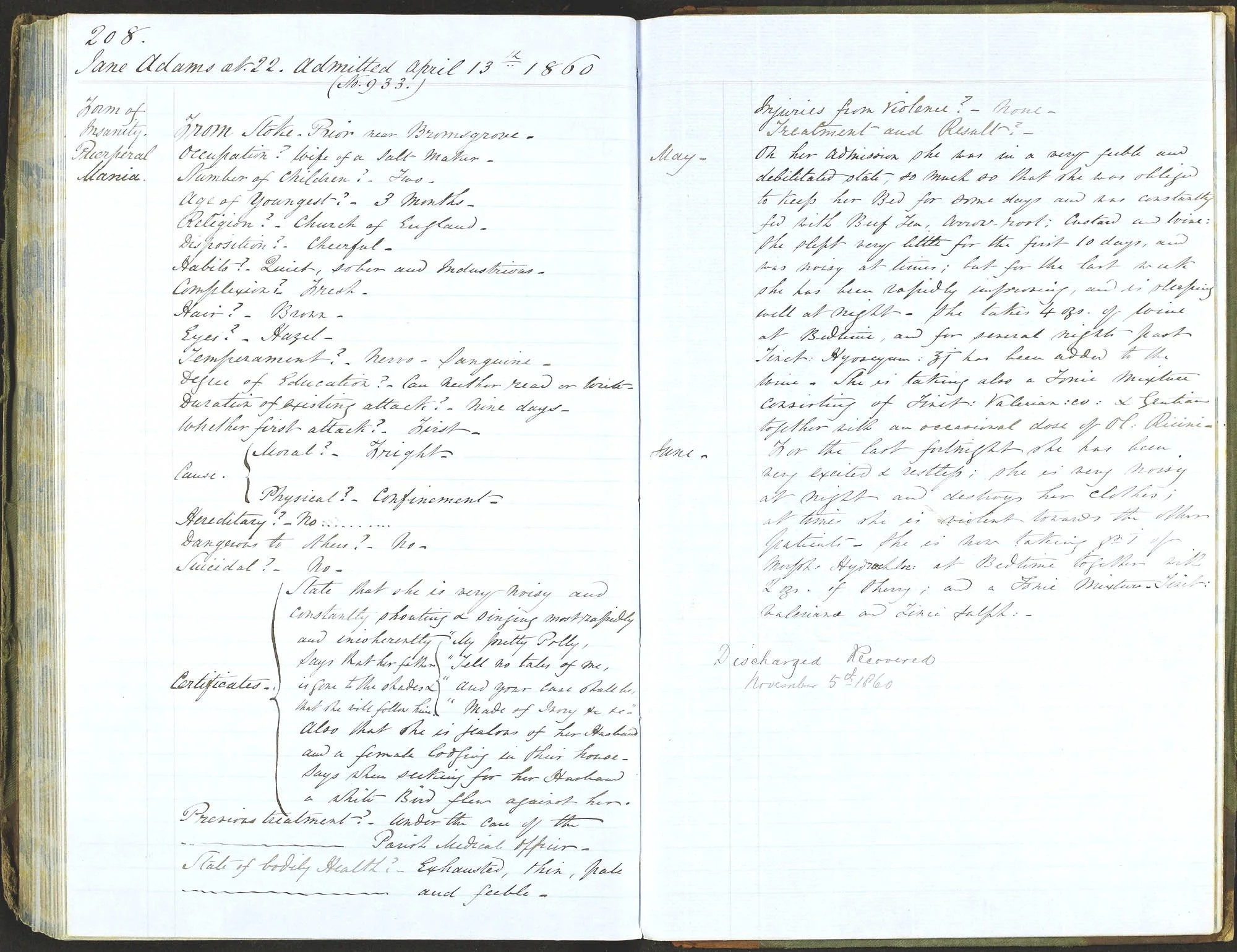
On this first admission, on 13 April 1860, it was noted that Jane had two children, the youngest of whom was only three months old. On admission she was said to be ‘exhausted’, and ‘she was in a very feeble and debilitated state, so much so that she was obliged to keep to her Bed for some days and was constantly fed with Beef Tea, Arrow-root, Custard and Wine.’ There is also a somewhat cryptic note that she ‘Says that her father is gone to the shades & that she will follow him.’ This might refer to the death of Richard, as there is a burial record for a Richard Newman on 28 November 1859, aged 63. Unfortunately, this man died in Kidderminster. The only Richard Newman who died in Eckington around this time was buried in 1865.
Jane was said to have ‘been very excited & restless; she is very noisy at night and destroys her clothes’. She was treated with morphine and valerian, as well as various tonics, and by 5 November she had recovered enough to be released.
At the census of 1861, Jane was living with her husband and two children in Stoke Prior. By the time of the next census, she had seven children, six of whom were living at home – Fanny, Sarah, George, Mary, James, and Thomas, born in 1858, 1861, 1864, 1866, 1869 and 1870, respectively. Charles, the son who was born just before her first admission, was living with his grandmother, Mary Adams, in Binton, just outside Stratford-upon-Avon, and was working as an agricultural labourer.
Jane was admitted to the Asylum for the second time on 5 December 1872, the cause of her Puerperal Mania said to be ‘effects of Confinement (she having been confined Nov. 16th).’ She was ‘constantly singing, sleeps very little & is at times violent.’ She also suffered from a suppurating breast, which ‘was opened, & is now greatly reduced but still hard & discharging slightly.’ The case notes do not mention any treatment for this problem, which must have been very painful. Instead, as usual, the asylum staff seemed to have been more concerned with her behaviour. On 5 February 1873 she was noted as ‘Quieter & better conducted than formally, the excitement & waywardness of behaviour having in great measure subsided.’ She ‘Continued to progress favourably,’ and was released on 31 March.
Two more children were born after this second incarceration, making ten children in total. Little wonder that Jane was exhausted! Would she have spent time in the Asylum if contraception had been widely available in those days?
In the 1881 census, the family was still living in Stoke Prior, with the eight youngest children still at home. Fanny was working as a servant in Bromsgrove and Charles was already married. At the following census, four of the youngest children were still at home, plus a grandson. Some of the older children had married and moved away. In fact, all but three of her children married, and Jane had at least 31 grandchildren.
George died in 1895 and was buried on 30 October. In the 1901 census, Jane was living at Stoke Prior with her youngest daughter, Elizabeth, and two grandsons, William and John, who must have been the sons of one of her older children, as William was only two years younger than Elizabeth. A baptismal certificate for a William George Adams, baptised in 1881, gives his mother’s name as Sarah. Was this her daughter Sarah? A baptismal certificate for John has not been found.
Jane died shortly after the census was taken. She was buried in Stoke Prior on 11 July 1901.
Research by Cathy Broad, 2026
To view Jane’s patient records, click here.
Go back to find out about more people who were patients at the asylum.