OUTSIDE THE ASYLUM
Can you help George Marshall Medical Museum with a spot of family history research to find out about some people who were admitted to the Worcester City and County Lunatic Asylum in the 19th century?
Our aim is to share more patients’ stories, and to find out about their lives before admission and (where possible) after discharge.
george reed
find out more about george reed
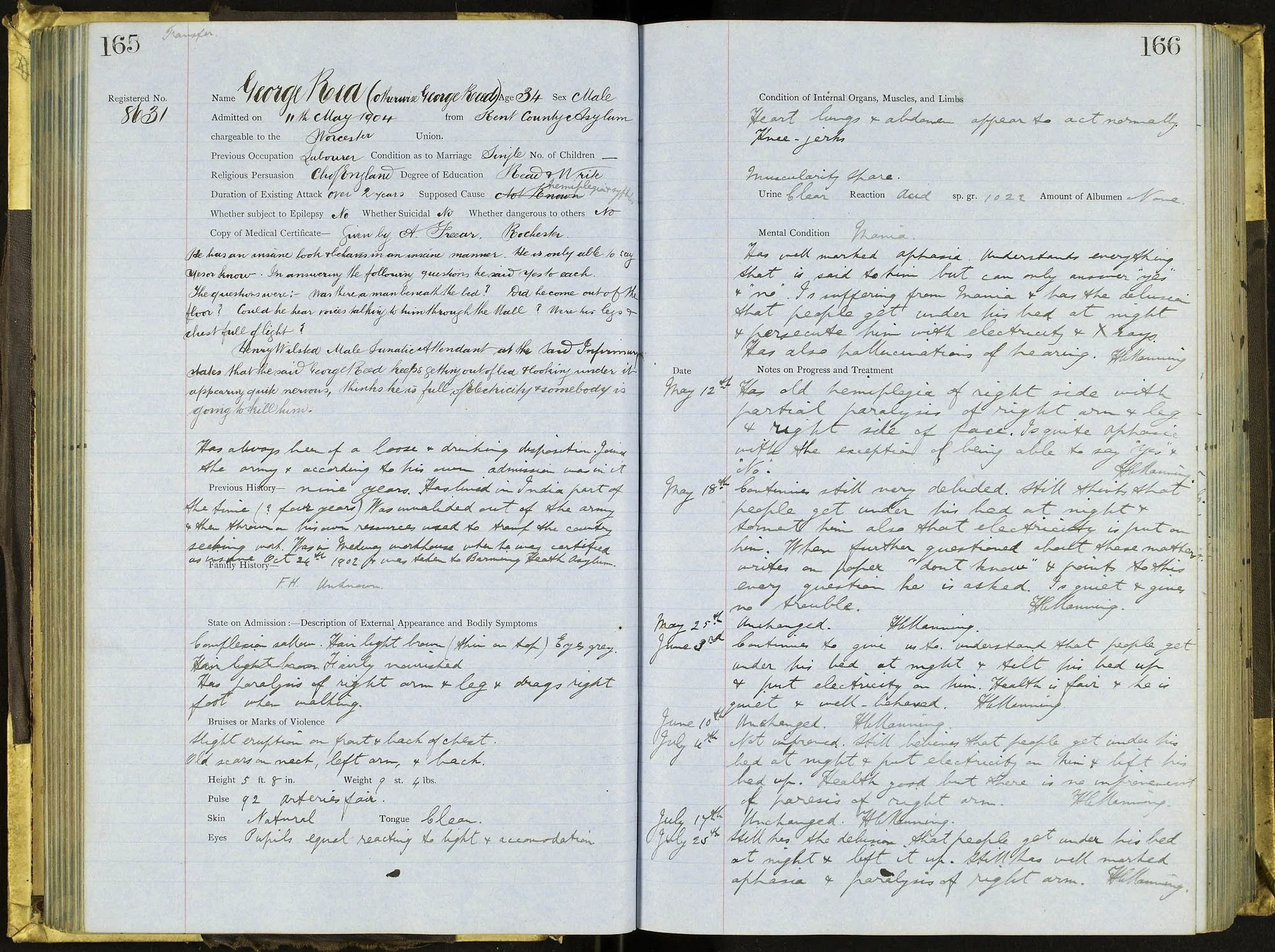
The writing of the name was confusing, but I decided to go with George Reed and assumed that at birth he lived in the Worcestershire area, as he had been transferred back to the Worcester City and County asylum, on the 11th of May, 1904 from the Kent county Lunatic asylum and a note was ‘chargeable to Worcester’. At this admission his age was stated as 34years old and occupation as labourer.
On admission to the Worcester City and County Asylum, he was described ‘as fairly nourished, with grey eyes and light brown hair which was thin on top’. His complexion was sallow and it was noted that he had paralysis of his right arm and leg, which he dragged when he walked. He had marked aphasia, but understands everything that is said to him. He could answer yes or no.
I also found a reference for the admission of a George Reed to the Barming Heath Asylum, near Maidstone, Kent, also known at the Kent County Lunatic Asylum. There are no notes from this time, but a report by Henry Wilsted, a male lunatic attendant from Kent asylum given at the time of his transfer to Worcester city and county asylum, stated that ‘he keeps getting out of his bed and looking under it, appearing quite nervous – he thinks he is full of electricity and somebody is going to kill him. A medical report by A. Frears’ (Rochester) stated ‘he has an insane look and behaves in an insane manner’. He answers yes or no. His diagnosis at this time was mania, with hallucinations of hearing.
Only a few months of records are available, up until August 1905, the record states that further notes are in Volume 4. Apparently volume 4 is still closed and in care of the Hive, Worcester. The notes that can be seen, written by the attendants claim ‘little change in his delusions, that there was someone under his bed and that electricity is put on him in the night’, his belief remained that he would be killed and continued to hear voices. There was no improvement in his paralysis or aphasia.
One thing of note is that on the 26th of September 1904, he was observed as part of a special report to the Commission in Lunacy as regards his continuation order.
The report states that he is still suffering from Mania, has delusions of persecution, imagining that people get under his bed at night and lift it up, also that they put electricity and x-rays on him. He still has hallucinations of hearing. He is well nourished, still has marked aphasia, can only answer yes or no to questions. Right arm and leg and part of face are partially paralysed.
There was no other information, available on admission, or visits from any friends or family during this time, however, the initial record, claims he had a loose and drinking disposition, he had joined the army and according to his own admission was in it for 9 years, 4 of them in India. He had been invalided out of the army and thrown on his own resources’, it also mentions that he took to ‘tramping the countryside, seeking work’. He had been in the Medway workhouse when he had been certified insane and transferred to the Kent asylum.
I’m a bit confused as to how they established this information, from George if he could only answer yes or no. however it may be the Hemiplegia was sustained during this first admission. There is no record of being invalided out of the army, but his admission to the Medway workhouse, was recorded as from Chatham and he was accompanied by a Cpl Howe’s. From my research there was a military hospital, with an asylum wing at Chatham at that time.
Fort Pitt hospital was built at the start of the 19th century, when Britain was at war with France and was named after Prime Minister William Pitt. After the defeat of Napoleon in 1815 the site became a military hospital initially housing wounded soldiers from the Afghan and Sikh wars 1815-1854. In 1847 the hospital also began to admit patients suffering from mental illness. It continued as a military hospital during WW1 and closed in 1922.
I cannot find evidence of George Reed on the 1891 or 1901 census, or any other military reference. However a person of this name was awarded the India medal, 1st Somerset Battalion Light Infantry, for participation in the Punjab frontier wars, including Tirah, Malakand and Samana all during the years 1897-1898. There is also a record of a George Reed, serving in South Africa, the Boer War, participating in the battles of Spion Kop and Relief of Ladysmith 1900 for which he received the Kings South Africa medal in 1902. This information would benefit from further investigation with the regiment.
In respect of his family, my best guess would be he was born in the Dudley area, his parents, James and Elizabeth marrying in 1870. He had two younger brothers, Arthur born 1873 and William 1877.
In 1881 the family are together, living in Wednesbury, James is recorded as a glass gatherer and the children scholars, which might suggest they were all in education. Their father, James died in 1888 when George was 14 years old. In 1891 the family are split up, with Arthur as a lodger with a family in Wednesbury working as a glass worker and William was a pauper scholar in West Bromwich. Elizabeth was a pauper inmate at the West Bromwich work house. The loss of James may have contributed to George’s decision to join the army. I can’t find what happened to Elizabeth but William is recorded as a stepson in the 1901 census, but Elizabeth does not appear. Arthur died in WW1 and William during WW2. The family all seemed to work in local the industry of steel and glass.
Records states that George died, whilst still a patient in 1930.
References
www.medway.gov.uk -Fort Pitt hospital
www.northeastmedals.co.uk britishguide/indiageneralservice1895.htm
Research by Vanessa Page Lloyd, 2026.
Go back to find out about more people who were patients at the asylum.