OUTSIDE THE ASYLUM
Can you help George Marshall Medical Museum with a spot of family history research to find out about some people who were admitted to the Worcester City and County Lunatic Asylum in the 19th century?
Our aim is to share more patients’ stories, and to find out about their lives before admission and (where possible) after discharge.
frances stretton
find out more about frances stretton
Stratton, Shellen, Streaton, Shelton
The misspelling in the transcription of Frances’s surname has hampered research, as has the fact that on admission to the Asylum, Frances was recorded as an “orphan” and so no parental names were given. Is Frances the same person as Frances Elizabeth Stretton or indeed Frances Streaton? In addition her birthdate and her admission date falling between censuses make it difficult to trace Frances on official records. A further complicating factor is that the typed patient information notes for Frances indicated that she was discharged on the 3rd April 1899, having recovered but notes exist for her as an inpatient in 1901 and 1902. Was she readmitted at some point or is the discharge date wrong? In March, 1904 there is a Frances Stretton age 31 (thus born in 1873 which tallies with other records associated with Frances) who died in Upton on Severn.[1]
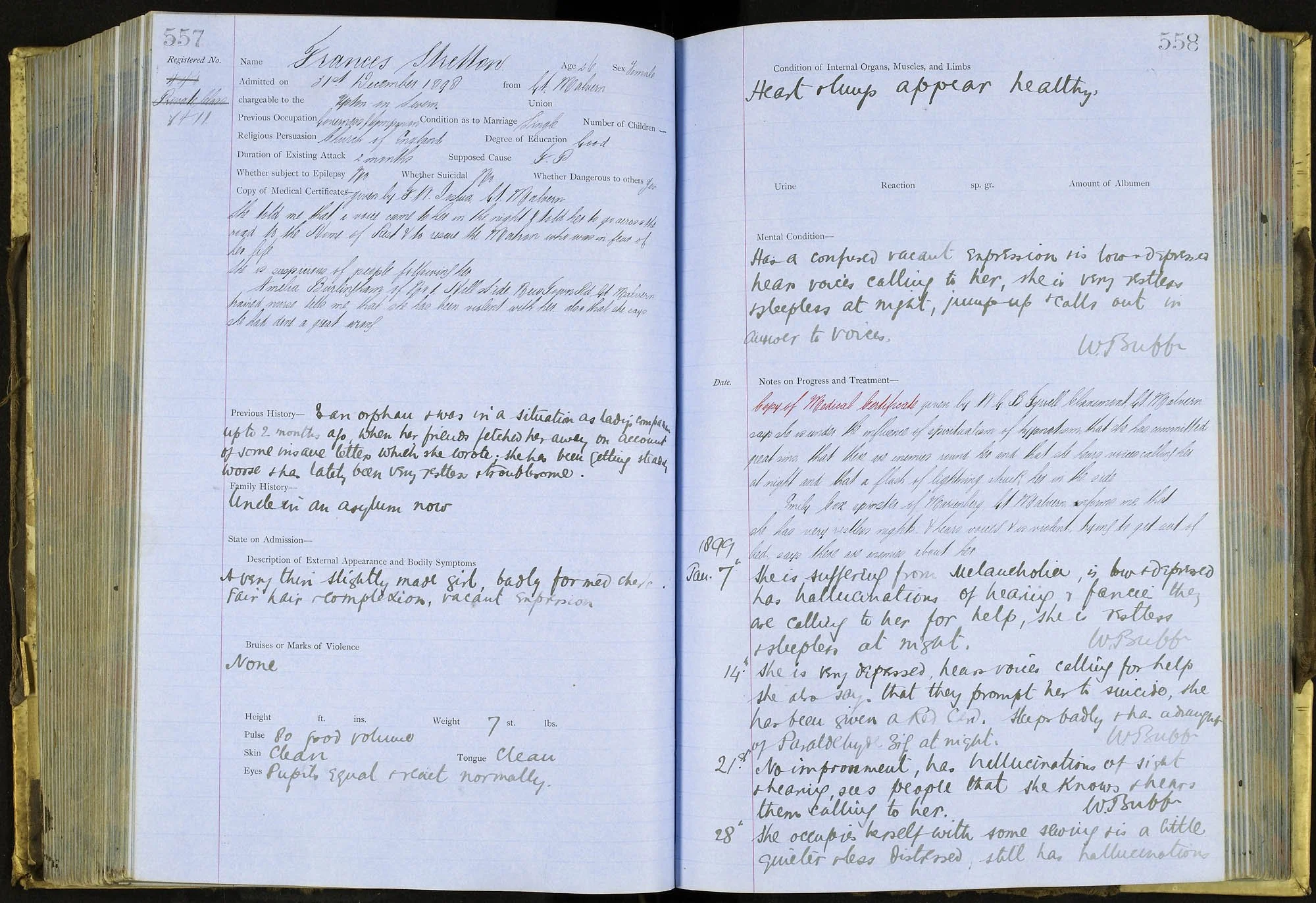
What we do know is that Frances was admitted to the Asylum, suffering from melancholia in December, 1898 when she was 26 years of age, suggesting she was born around 1872. Her religion was given as Church of England and her occupation recorded as Governess/Companion, residing in Greater Malvern. Looking at the dates on her admission notes it would appear she was a lady companion until October, 1898 when friends fetched her away due to her writing “insane letters.” It appeared she has been suffering from ‘attacks’ for 2 months, which her friends reported were worsening and is “low and depressed.” Her notes add that her uncle is in an Asylum but his name is not mentioned.
Bodily, Frances was a “very slightly made girl,” weighing 7 stone with “a badly formed chest” (which maybe suggestive of TB, although there is no record of this disease on her notes). Frances had fair hair and a fair complexion. It is noted that she had a “vacant expression and is very restless and sleepless at night and often jumps up to calls out”. Her admission records are marked “dangerous to others.” Frances reported that she hears voices that ask for help and says she has committed “great sins”. The voice at night is calling her to go across the road to the House of Rest and to visit the Matron who was in fear of her life. She is also suspicious of people following her. The Medical Certificate prepared by J.M. Joshua stated that Amelia Burlingham, a trained nurse had visited Frances who told her she had done “a great wrong.” The 1901 Census recorded Amelia as living at 338, Birchwood Villas, Albert Park Road, Malvern so when Frances “went across the road to the House of Rest”, was she too living in Albert Park Road?[2]
Frances’ notes also mention an Emily Cox from Marienberg, Worcester Road, Malvern. Emily informed the medical certification doctor that Frances was restless at night and that “there was something insane about her.” Whether Emily was the friend who fetched Frances away to live with her in the months prior to admission or whether Frances was Emily’s lady companion is open to conjecture. Emily was born in 1850, the daughter of Thomas Cox, a silk merchant and draper [3] and in the 1891 Census is a spinster, living at 167, Marienberg, Worcester Road, Malvern on her own account. Also present at the address is a visitor from Scotland, Jane Connell and 3 servants.[4] Emily is at the same address in the 1901[5] and 1911 Censuses[6]. Emily died in 1915[7] and is buried in the Municipal Cemetery in Great Malvern.[8]
We cannot ascertain definitively how Amelia Burlingham or Emily Cox are linked to the story of Frances. On April 22nd 1900, Frances has a visitor (no name or gender is recorded on the notes) and Frances accuses them of cruelty in sending her there and said if she has a pistol she would shoot them for it. Was the visitor Amelia or Emily or someone else?
Returning to Frances’s life before her admission and focussing on her occupation as a governess/lady companion, an examination of the 1891 Census finds a Frances E. Stretton living in Winchester, Hampshire with a schoolmistress. Frances’s occupation is Governess. Is this our Frances? Her birthplace is given as Finsbury in 1873 [9] and indeed a birth is recorded for a Frances Elizabeth Stretton in the first quarter of 1873 in Pancras.[10]
A Francis Elizabeth Stretton born in 1872/3 has not been found in the 1881 Census but a Frances E Streaton (sic), aged 8 is recorded as a visitor to the household of William and Mary (nee Faris) Stevenson. This Frances is recorded as being born in Finsbury. Also present is a Eleanor H. Faris a missionary district visitor, born in Cavan, Ireland in 1835.[11] In the 1871 Census, Eleanor is recorded as an Infant school teacher.[12] On the 27th December, 1871, at St. Judes, Gray’s Inn Road, London an Eleanor Faris is present at the wedding of James Stretton, a druggist to Elizabeth Elliott. As well as Eleanor, the other witness is Gustavus Mark Bothwell, a merchant, who emigrated to Australia in 1884 and like Eleanor, a native of Killashandra, Cavan.[13] May this suggest that Elizabeth Elliott’s or James Stretton’s family originated from Cavan too? At the time of the marriage James and Elizabeth both appear to be living at 48, Liverpool Street, London. Elizabeth’s father is named as Andrew Elliott, a clerk and James’s father is named as John Stretton, a farmer and it is noted that both bride and groom were born in Ireland. Thus, it is proposed that Elizabeth and James Stretton are Frances’ parents.
A further scrutiny of the 1881 Census revealed a James Stretton, an unemployed druggist living in Woodstock Road, Finsbury with his wife Elizabeth and 2 sons, Archibald John J. Stretton aged 5 and, Percy, aged 3.[14] This 1881 entry would explain Frances being recorded as a ‘visitor’ on her 1881 Census record. The 1880 London Electoral Register also locates James Stretton living at 11, Woodstock Road, Finsbury Park in an unfurnished, two room dwelling, one room on the first floor and one room on the second floor. The rent is £22 and 2shillings per annum (c £2,340 in today’s money).[15] By 1883 the Electoral Register has a James Stretton living at 136 Saint Paul’s Road, Finsbury.[16] The 1885 London Trades Directory has a Mrs J. E. Stretton, stationers (retail) at 136, Saint Paul’s Road, does this mean Elizabeth is now a widow and that James’ occupation changed from druggist to stationer? [17]
A search of birth registrations, found Archibald John J. Stretton, born in the second quarter of 1875 in Pancras (like Frances) and Andrew Percival Stretton born in the second quarter if 1877 in Edmonton.[18] Further support for Archibald and Andrew being Frances’s brothers is illustrated by the baptism of 3 children on the 16th September, 1883 at St. Paul’s, Canonbury, Essex Road, Islington.[19] Baptised were the children of James Elliott Stretton and Elizabeth Somerville Stretton (sic). The parents middle names appear to be assigned to the wrong parent. The 3 children baptised are Frances Elizabeth Stretton born on December, 15th 1872, Archibald John James Stretton, born May 9th 1875 and Andrew Percival Stretton born on the 23rd June, 1877. The father’s occupation is given as Stationer. It was not unusual for children taken into care to be baptised if it was not known if they have previously been baptised. This supposition could also explain the error in the parents names. Although, the trade directory of 1885 suggest that Elixabeth Stretton was still alive at the time of the baptism but was maybe a widow or ill and the children were foundlings rather than orphans. What happened next to Archibald and Andrew further supports the assertion that the family had fallen on hard times. Archibald and Andrew became Canadian ‘Home Children.’
As was found with Frances’ records the errors in transcription of the family surname continued. In 1886, an Archibald John James Stretton aged 11 sailed from Liverpool to Ontario on the 29th July 1886. Also on board was Andrew Shelton (sic) aged 9. A scrutiny of the original record revealed the surname was Stretton, Andrew Stretton. The ship, the Sardinian was on route to the Annie MacPherson Home in Stratford, Ontario. Annie MacPherson was an evangelical Quaker who ran a home for orphans and poor children. The boys were trained in trades like tailoring and shoe making and the girls in domestic service. The Annie MacPherson home was originally located at 60 Commercial Road, London before moving in the late 1880’s to the corner of Bethnal Green Road. By the time of her death in 1904, she had transported 12,000 London children to Canada. [20] Annie herself was on board the Sardinian with the Stretton boys, which docked in Quebec on the 7th August 1886. The Stratford Home (51, Avon Street, Stratford, Ontario) had been opened in 1883 but unfortunately available records for Stratford only start in 1893. After time at Stratford, the Stretton brothers were placed with families. Andrew was placed with John Squires, Mornington Township, Ontario and a Andrew Percival Stretton can be found on the 1891 Canadian Census living in a farming community in Mornington Perth North, Ontario and recorded as an adopted son.[21] By 1901 the Canadian Census records Andrew as a boarder, living in the York district of Toronto, interestingly his religion has changed from methodist to spiritualist.[22] In 1914 he married his first wife in Winnipeg, Manitoba whom he divorces in 1920. By 1931 he has moved to Calgary and an article in the Calgary Herald [23] reports that he came from England in 1886 and was farming in Ontario for 10 years before coming West. He won a slogan competition at the World Grains Conference which garnered much press coverage. In 1923 he married, his second wife in Knoxville, Tennessee and in 1934 applied for US Citizenship. His citizenship application described him as 5ft 8”, with brown hair and eyes and he had driven from Canada, entering the country via Montana. He was working as a Freelance Press Corps and had no children. By 1950 he was living in Spencer City, North Carolina and died there in 1950.His obituary said he was working on a new powerhouse for The Duke Power Company and was working when he was taken ill and he was ill for one week. His obituary states he was the author of many articles of a political nature and 2 books, Republican Reveille and We Reap what we Sow.[24] He is buried in Chestnut Hill Cemetery, North Carolina.[25]
As for Archibald, in 1891, there is a James Stretton aged 14 working on a farm in Grey East, Ontario where he is recorded as a servant. Also at the address is a 14 year old girl who is confirmed as an Annie MacPherson girl and so it is assumed James is Archibald.[26] There is a WW1 Draft Registration card for Archibald John James, a 45 year old man of medium height and build, with light hair colour and blue eyes, born in England on the 9th May 1875.[27] His occupation is given as Labourer for Ben Iverslee at Park River, Walsh County, North Dakota. The ‘Nearest relative’ column is left blank and his permanent address is Cut Bank, Teton County, Montana. The next record is for a James Stretton working as a cook on a railroad at Flat Head Montana. I wonder if Andrew entered America via Montana to see his brother or was it just the best route to drive south from where he was living?
We can never be sure why Frances remained in England but in 1886, she would have been 13 and perhaps she was engaged in employment or taken in by a relative? Unfortunately, no newspaper reports or other documentary evidence has been found for Frances for this time. Eleanor Faris who Frances was with in 1881 was married in Islington in the second quarter of 1883 to William Price.[28] Eleanor died on the 14th February 1896 and is buried in Highgate Cemetery, London.[29] Did Eleanor and Frances keep in touch? She certainly cannot have been the visitor to the Asylum.
Whilst her brothers were making their lives in Canada and her old friend Eleanor was raising her own family, Frances was an inmate at Powick. Frances’ time in the Asylum appeared to be peppered with references to screaming at night, violence towards staff, apathy and constipation. Shortly after her admission (14th January, 1899), she is hearing voices prompting her to suicide. By the 28th January she is undertaking some sewing and appears less distressed but is still hallucinating. Her notes (10th April,1899) show she has been prescribed a draught at night. By June 8th she is “somewhat improved” and in July, 1899 her red card is removed. However, by September she seems to be regressing as it is noted that she does not “attempt to employ herself” and “seldom notices when addressed.” Unfortunately, by December she had relapsed into “a dull apathetic state.”
The following year, 1900, Frances “has lost flesh and not looked well” and she is prescribed daily cod liver oil – constipation seems to have plagued her throughout her time at the Asylum. By July, 1900 Frances had “improved very much physically, gained weight, is eating well and taking interest in surroundings”. There is then another decline and on December, 4th Frances is melancholic and “disinterested and slow in movement.” The records for January,1901 show a “ little improvement in mentality” and that she is “more willing to converse”. However, by April 1901 there is “no improvement” and Frances is complaining of a pain in her left side and as she is often seen as suffering from constipation, is again prescribed cod liver oil. On her admission notes Frances reported that she has been struck by lightening on her left side and one can wonder where the physical and mental pain coalesce.
There appears to be a further deterioration in Frances’s condition as in October, 1901 she is “more excited these last few weeks” and is “very noisy and very thin despite a milk diet.” She is also accused of “viciously” assaulting a nurse. The next notes for Frances in October, 1902 state that she is still the same “ violent and noisy and screaming at night.”
What “great wrong” Frances believes she committed seems to have prompted or at least exacerbated her “insanity”. It should be remembered that an uncle was also in an asylum and there maybe a congenital propensity to mental illness. However, the use of the word sin, the night terrors, voices asking for help and the appearance of a “home of rest” and a midwife in Frances’s story do give rise to the possibility the “sin”/ the “great wrong” was of a sexual nature or linked to infanticide, perceived or otherwise.
The three Stretton siblings had very different lives but all had been institutionalised for parts of their lives and were along way from their London birthplace when they died. Their parents, their birthplace and the time spent with siblings lost in the mists of time, as they were lost from each other.
I would like to acknowledge the Home Children Canada Research Group (Facebook) for their invaluable help with this research.
Home Children Canada #42803 Archibald John James Stretton #28019 Andrew Percival Stretton.
[1] England and Wales, Civil Registration Death Index, 1837-1915
[2] Census Returns of England and Wales 1901.TNA Kew, Surrey, England
[3] Worcestershire, England, Church of England, Births and Baptisms, 1812-1922 (database on line), Lehi,
UT, USA
[4] Census Returns of England and Wales 1891.TNA Kew, Surrey, England
[5] Census Returns of England and Wales 1901.TNA Kew, Surrey, England
[6] Census Returns of England and Wales 1911.TNA Kew, Surrey, England
[7] Worcestershire, England, Church of England Deaths and Burials,1813-1997
[8] Web Global Gravestone Photography Index 1265-2014
[9] Census Returns of England and Wales 1891.TNA Kew, Surrey, England
[10] England and Wales, Civil Registration Birth Index, 1837-1915
[11] Census Returns of England and Wales 1881.TNA Kew, Surrey, England
[12] Census Returns of England and Wales 1871.TNA Kew, Surrey, England
[13] London, Church of England, Marriages and Banns, 1754-1940, London Metropolitan Archives, London.
[14] Census Returns of England and Wales 1881.TNA Kew, Surrey, England
[15] London, England, Electoral Registers,1832-1972
[16] London, England, Electoral Registers,1832-1972
[17] London, England, City Directories, 1736-1943
[18] England and Wales, Civil Registration Birth Index, 1837-1915
[19] London, England, Church of England Births and Baptisms, 1813-1924
[20] Annie MacPherson and the Gutter Children. Spitalfields Life November 25th 2015
[21] 1891 Canadian Census
[22] 1901 Canada Census
[23] Calgary Herald 18/4/31
[24] The State Columbia, South Carolina 23/9/50 p.7
[25] FindaGrave Memorial ID 86710686
[26] 1891 Canadian Census
[27] US, World War 1 Draft Registration Cards, 1917-18
[28] England and Wales , Civil Registration Marriage Index, 1576-1915
[29] Web: UK, Burial and Cremation Index, 1576-2024
Research by Clare Brindley, 2025.
To view Frances’ patient records, click here.
Go back to find out about more people who were patients at the asylum.