OUTSIDE THE ASYLUM
Can you help George Marshall Medical Museum with a spot of family history research to find out about some people who were admitted to the Worcester City and County Lunatic Asylum in the 19th century?
Our aim is to share more patients’ stories, and to find out about their lives before admission and (where possible) after discharge.
florence penn
find out more about florence penn
This is a rather tragic tale of a young life wasted, and a reminder to us that we are very fortunate indeed to live in an era of diseases that are mostly treatable, thanks to our wonderful NHS. Poor Florence had no such advantages, and seemed to be doomed to a short life right from the start.
Florence was born in Kidderminster in 1859. The birth index does not give her exact date of birth, and there is no baptism record. Her first appearance in a census record was in 1861, as the daughter of William, a worsted carpet weaver, and Mary A, a dressmaker. She had an older brother, William, aged 8, and the family lived at 8 South Street in Kidderminster.
William Penn was born in Kidderminster, probably in December 1828 or January 1829, to James and Leah Penn. He was baptised on 26 January 1829. His father James was a horsekeeper. According to the 1841 census, William had three older sisters.
He married in 1850, but his wife’s name is not certain. There are two women, Mary Ann Cox and Mary Ann Smith, who could be William’s wife. In the 1851 census, William and Mary were living in Bromsgrove Road in Kidderminster. Mary Ann died in 1864 and the following year William married a woman named Emma. In 1871, the family, which now included two younger children, John and Mary, were living in Comberton Road, Kidderminster.
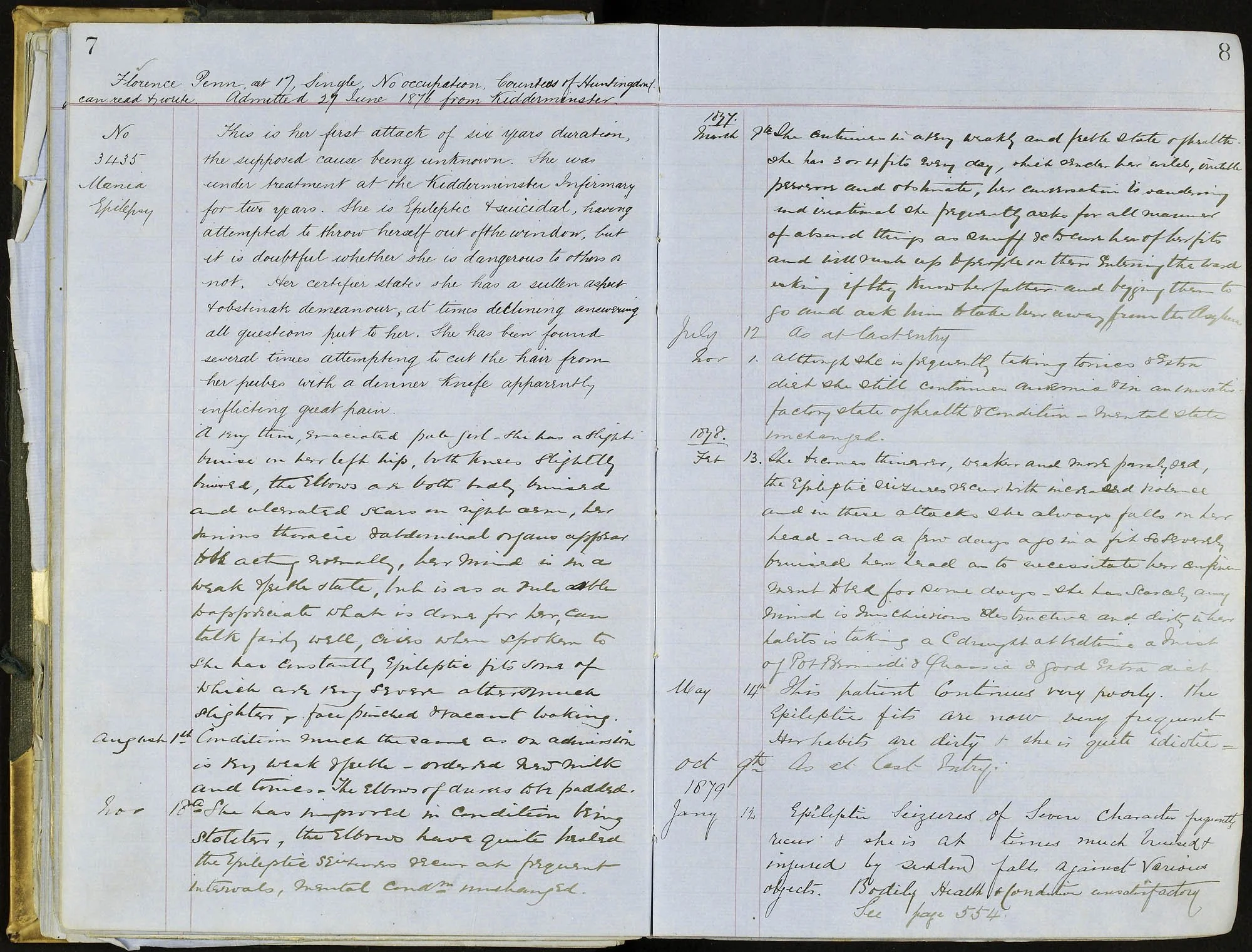
Florence was admitted to the Powick Asylum on 27 June 1876, aged 17, her maladies being described as Mania and Epilepsy, which had lasted for six years. Her admission notes state that she was a ‘very thin, emaciated, pale girl’, with ‘a sullen aspect & obstinate demeanour’. She was also said to be suicidal, ‘having attempted to throw herself out of the window’.
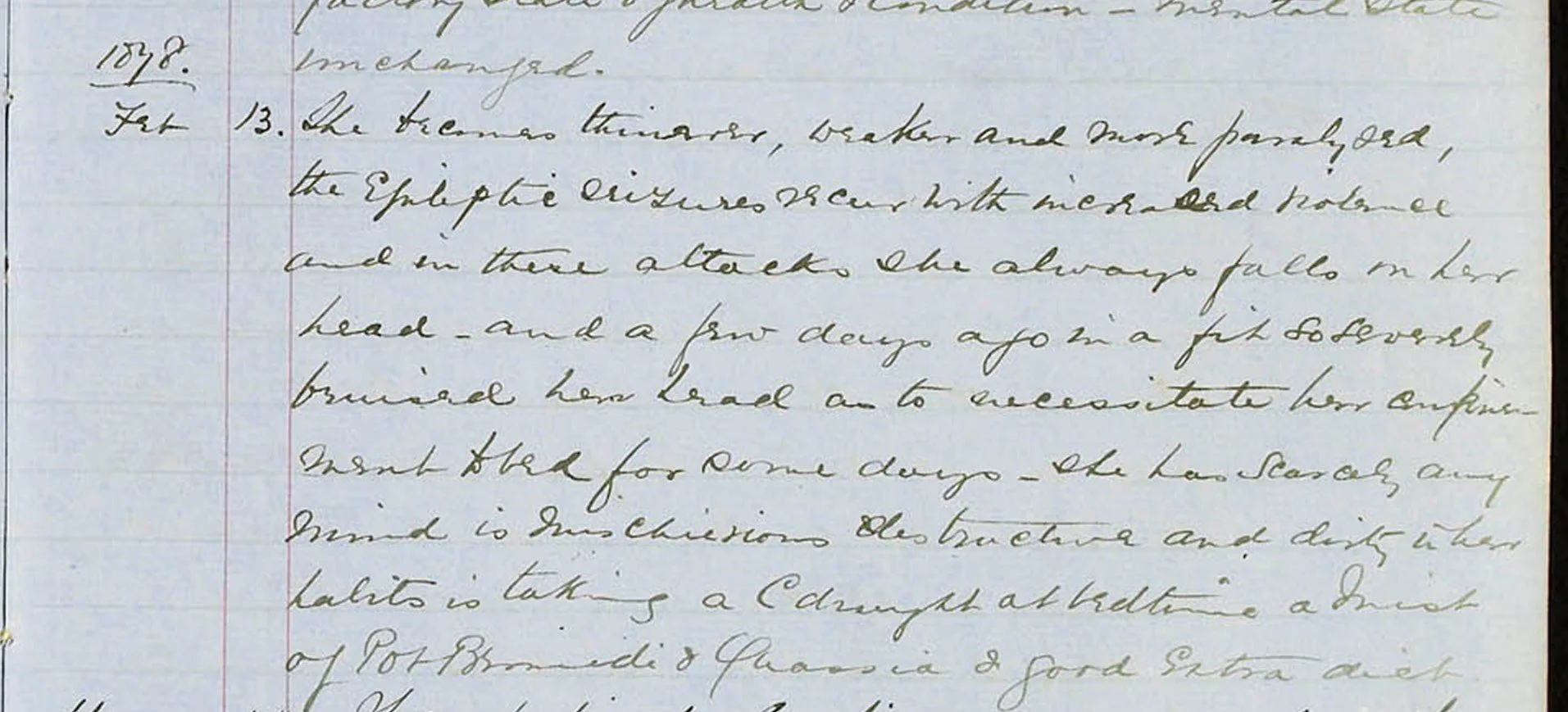
During the four years that she spent in the asylum, Florence regularly suffered epileptic fits which do not appear to have been treated. At this time, the standard treatment for epilepsy was the administration of bromide. Only once in her case notes does it mention that she was given bromide, yet almost every note records that she was suffering regularly from fits. On 9 March 1877 the note reads ‘She continues in a very weakly and feeble state of health – she has 3 or 4 fits every day, which render her wild, irritable, perverse & obstinate.’ The rest of the note details her behaviour, but there is no mention of any kind of treatment.
‘Epileptic Seizures of Severe Character frequently recur & she is at times much bruised & injured by sudden falls against various objects. Bodily Health & Condition unsatisfactory.’ (12 January 1879). Again, there is no mention of any treatment; the asylum staff seem to be more interested in recording her behaviour rather than noting what they were doing to treat her maladies. The only treatment she appears to have had were various tonics to build up her health. On 1 November 1877, the case not records ‘Although she is frequently taking tonics & extra diet she still continues anaemic & in an unsatisfactory state of health & condition – mental state unchanged.’
Finally, on 17 October 1880, the case notes read ‘This patient some month or five weeks back had a very severe attack of epilepsy & for some hours did not look like rallying. She recovered however: some 3 days ago she was noticed to be more than usually helpless & enfeebled, & was at once ordered to bed and put on stimulants etc: she never rallied again but became gradually weaker & finally died quietly today at 12 noon from “Exhaustion from Epilepsy of over ten years duration”.’
The lack of specificity in this entry is very telling. Florence had been suffering for four or five weeks before it was felt necessary to write a case note. She was put on stimulants, but these are not named. She eventually died after suffering from epilepsy for a decade, the last four years of which had been spent in an institution which seemed to be more concerned with her behaviour than with her medical condition. Once again, as has happened so often with these patients, it seems as though this unfortunate girl would have been better off if she had been treated in a hospital rather than in a mental institution.
Go back to find out about more people who were patients at the asylum.
Research by Cathy Broad, 2026