OUTSIDE THE ASYLUM
Can you help George Marshall Medical Museum with a spot of family history research to find out about some people who were admitted to the Worcester City and County Lunatic Asylum in the 19th century?
Our aim is to share more patients’ stories, and to find out about their lives before admission and (where possible) after discharge.
elizabeth randle
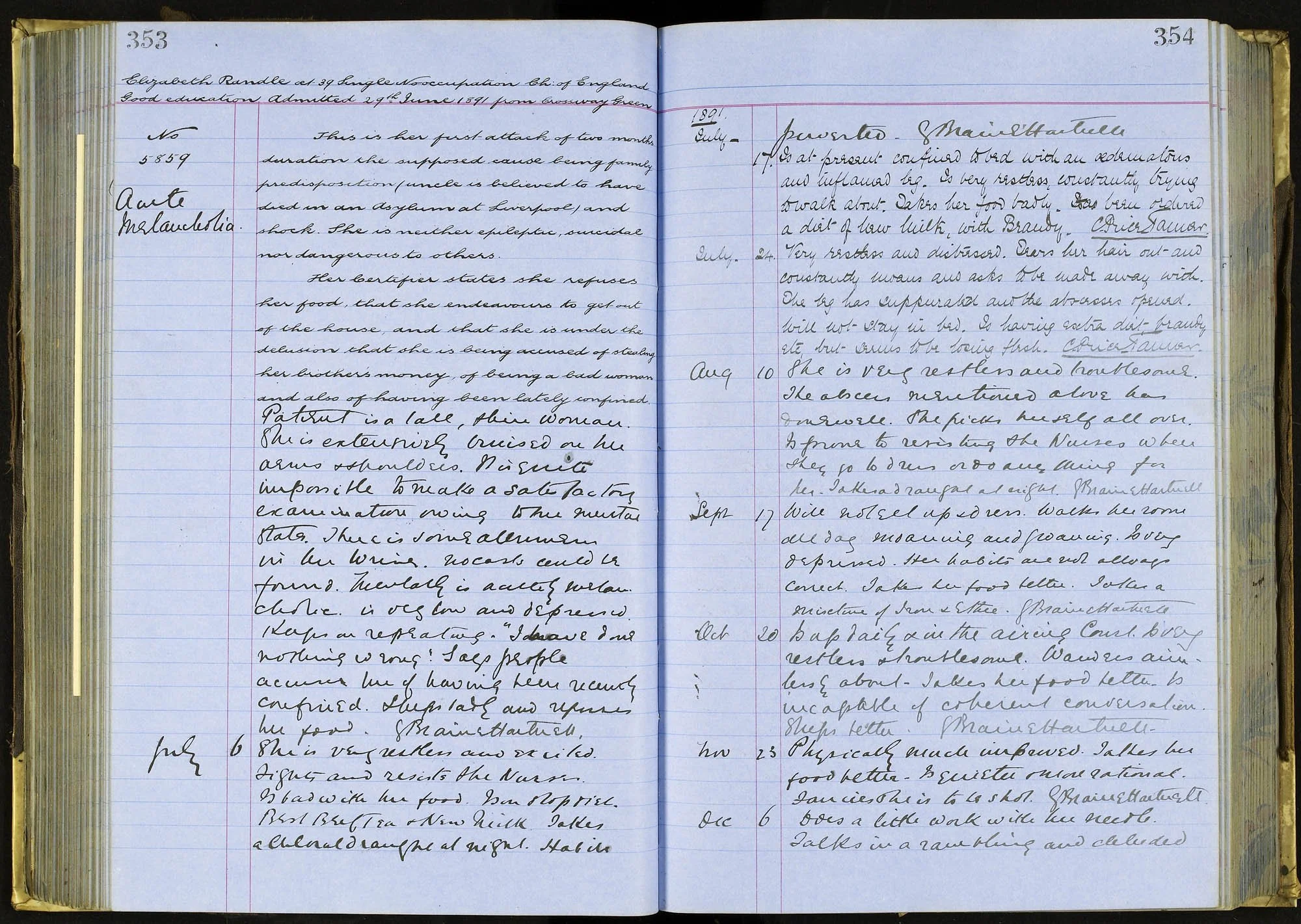
find out more about elizabeth randle
Elizabeth was one of those patients who seemed to bounce back and forth between the Powick Asylum and the outside world. She was admitted to the asylum three times between 1891 and 1896. This last time she stayed until her death in 1917.
Elizabeth was born in Hartlebury in 1851 to Allen Randle, a farmer, and his wife, Ann Williams. They had married on 6 November 1844, both listing themselves as ‘of full age’. The exact date of Elizabeth’s birth is unknown. The handwritten birth index does not give a date or even specify in which quarter of the year she was born. She was baptised on 28 July 1856, along with her two younger brothers Thomas and John.
She made her first appearance in a census return in 1861, when the family included seven children – Arthur, Joseph, Mary, Ann, Elizabeth, Thomas and John. It was a prosperous family. Allen listed himself as ‘Farmer of 157 acres employing 9 men, 4 boys and 2 women.’ Furthermore, the two oldest sons were listed as Scholars. Aged 15 and 14, they were old enough to work, and the fact that they were still at school says that their labour was not needed on the farm. Elizabeth was nine years old, so she must have been born between March 1851 and March 1852.
Allen died on 19 February 1866; his burial record gives his age as 49. The probate of his will notes that he left less than £1000 in effects – this would be over £100,000 today. Ann took over her husband’s farm, noting in the 1871 census that she farmed ‘180 acres employing 8 labourers & 1 boy’. All seven of her children still lived at home, as well as her mother.
The following census shows that the farm had diminished to 173 acres, and employed two men, two boys and two women. Only Arthur, Mary, Elizabeth, Thomas and John lived at home. Ann died on 19 March 1883, and in the 1891 census, the head of the household, surprisingly, was her youngest son John. All of his siblings except Joseph lived with him. He had died in November 1890, aged 43.
Elizabeth’s first admission to the Asylum was on 29 June 1891, suffering from acute melancholia. Her admission notes state that ‘she is under the delusion that she is being accused of stealing her brother’s money, of being a bad woman and also of having been lately confined.’ She slept badly and refused to eat. She was given beef tea and milk and prescribed a sleeping draught.
During this first admission, she was described as ‘very restless and troublesome’ and ‘incapable of coherent conversation.’ Over time she improved, gaining weight and doing some needlework, until by 2 May 1892 she was described as ‘Has no delusions, and talks cheerfully. Was accordingly allowed today to leave the Asylum on Trial.’ She was discharged on 6 June.
This situation lasted less than a year and a half. Elizabeth was readmitted on 18 November 1893. This time, one of the causes of her disability was said to be the recent death of her brother. As John and Arthur were both still alive, and Joseph had died three years previously, it must be assumed that the brother referred to was Thomas, but I have not been able to find a death record for a Thomas Randle of the correct age and with the right birthplace.
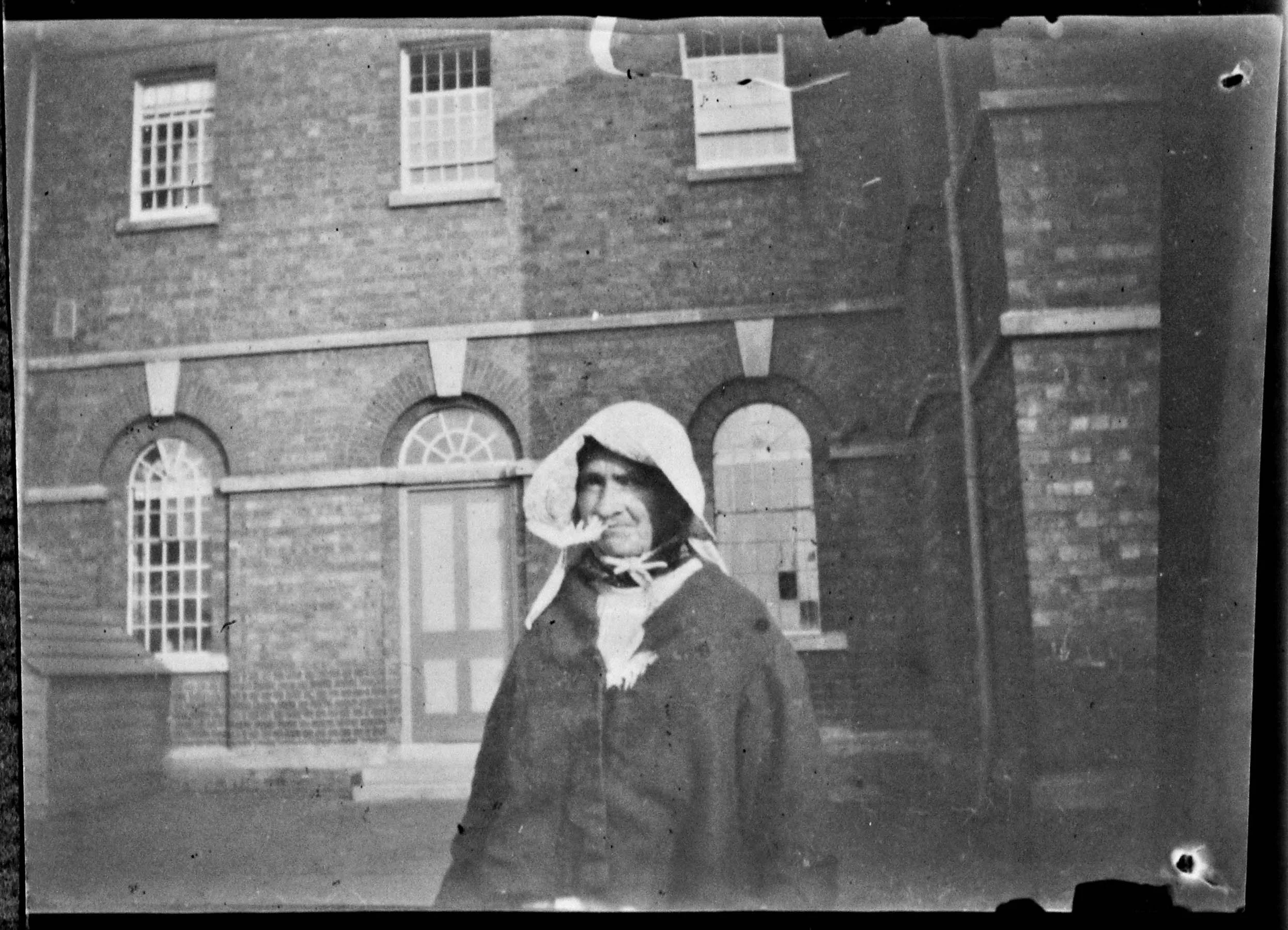
Elizabeth Randle
Her admission notes state ‘Patient is a thin woman. Her breath is foul and her tongue dull. She is in rather a feeble condition. Her heart and lungs appear normal. Mentally she is suffering from Mania, is restless and excited. Talks in a rambling way. Gesticulates and laughs without cause. Takes food badly.’
Throughout this second stint in the asylum, Elizabeth’s condition improved and her weight increased from 9 st 5 lbs to 10 st. 11 lbs, and on 2 July 1894 she was discharged.
Two years later she was back, being admitted on 3 August 1896. ‘She is suffering from Acute Mania: is restless, noisy and excited. Her conversation is incoherent. Her habits are perverted. She refuses her food. Is violent.’
Time and time again during the rest of her stay at Powick, her case notes read the same – she was excitable, incoherent, violent and destructive. There were periods when her condition improved, and on 19 December 1898, she was described as ‘doing well, is quiet & tractable & industrious, but she lacks self-control.’ These periods never lasted long, and she reverted to her excited state. Again and again, the notes read ‘No change’ or ‘No improvement.’
On 13 September 1917, Elizabeth was attacked by another patient, and ‘sustained a fracture of most of the 8th rib on the right side. She was strapped & bandaged and put to bed.’ She had recovered by 20 October, but was described as ‘very emaciated’ and by 3 November ‘She is back in bed owing to her weak condition.’ On 2 December ‘She is sinking fast. Pulse thready.’ Two days later ‘Died today at 11 am.’ The cause of death listed on the death certificate is Valvular Heart Disease.
This seems rather strange, as time and again, the case notes say that her heart and lungs are behaving normally. The first mention of a heart problem is on 20 October 1912, when the case note reads “Her heart is feeble & irregular in action & she is having cardiac stimulants.” Once again, as we have seen so often, it appears that the Asylum personnel were more concerned with the behaviour of a patient as the manifestation of their mental condition, rather than the possibility that the mental condition might have a medical cause.
Research by Cathy Broad, 2026.
To view Elizabeth’s patient records, click here.
Go back to find out about more people who were patients at the asylum.