ada bodycote
find out more about ada bodycote
Apart from a two-year period between July 1900 and September 1902, and seven months from August 1903 to March 1904, Ada spent the years from 1899 until her death in 1917 in mental institutions. Unfortunately, because records are either sealed or missing, we know what her life was like for only four years of this period.
Ada’s father, Richard, and her mother, Ann Worthington, had married on 7 March 1859, in St Philip’s Church in Birmingham. Richard was ten years older than Ann, but the couple had been neighbours in Creeds Building in Handsworth, according to the 1851 census, so they may have known one another for some time.
By 1861, according to the census return, they were still living in Creeds Building, with their daughter Hannah and Ann’s mother, Mary. Ten years later, Richard, Ann and Hannah had moved to No. 9, 7 Court, Bristol Street, Birmingham, and their family now included three sons, John, William and Arthur, and a daughter, Emma.
Ada was born on 19 January 1874, and baptised on 9 February in St Luke’s Church in Birmingham. By the end of the year, Richard was dead; his death, aged 59, was registered in Birmingham in the fourth quarter of that year.
In the 1881 census, Ann had moved with her family (except oldest daughter Hannah) to House 4, 11 Court, Sun Street, Edgbaston. By the following census, Ann was living in Franklyn Terrace, Harborne, Staffordshire, with John, Emma and Ada. Like her sister, Ada was working as a chocolate maker.
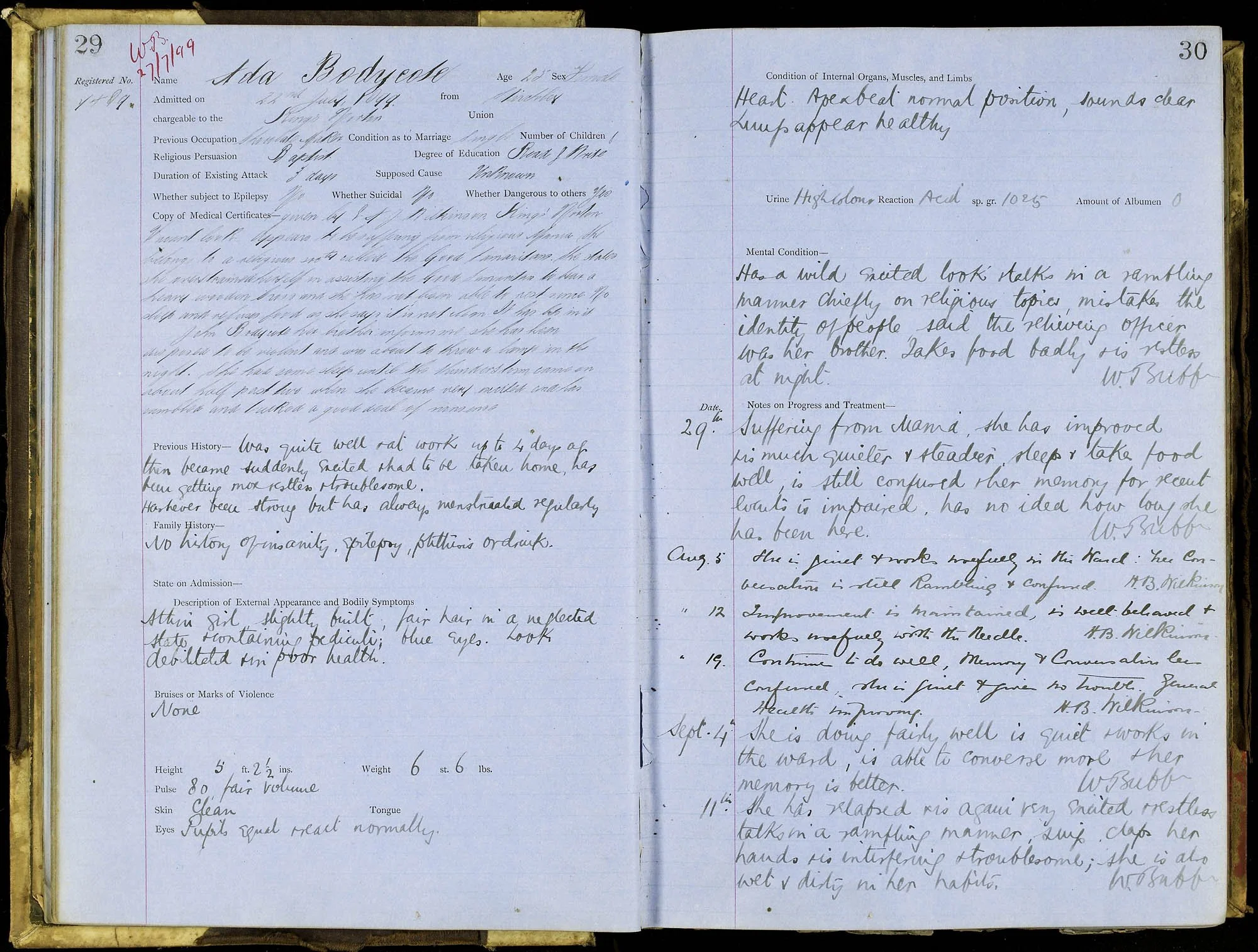
Ada was first admitted to the Powick Asylum on 22 July 1899. The medical certificate from the doctor who admitted her states ‘Appears to be suffering from religious Mania. She belongs to a religious sect called the Good Samaritans. She states she even trained herself in assisting the Good Samaritans to bear a heavy wooden brass and she has not been able to rest since. No sleep and refuses food as she says it is not clean.’
Her mental condition on admission described her as having ‘a wild excited look & talks in a rambling manner chiefly on religious topics, mistakes the identity of people, said the relieving officer was her brother. Takes food badly & is restless at night.’
Throughout the next few months, her condition improved, and on 4 September, she was being described as ‘doing fairly well, is quiet & works in the ward, is able to converse more & her memory is better.’ But only a week later her notes read ‘She has relapsed & is again very excited & restless, talks in a rambling manner, sings & claps her hands & is interfering & troublesome; she is also wet & dirty in her habits.’ However, she continued to improve and was released, deemed to be recovered, on 2 July 1900.
According to the UK Lunacy Patients Admissions Register, Ada was committed to Powick Asylum again, on 8 September 1902, and discharged, deemed recovered, on 3 August 1903. The medical notes for this period are in a volume that either has gone missing or was never deposited with the Worcestershire Archive and Archaeology Service.

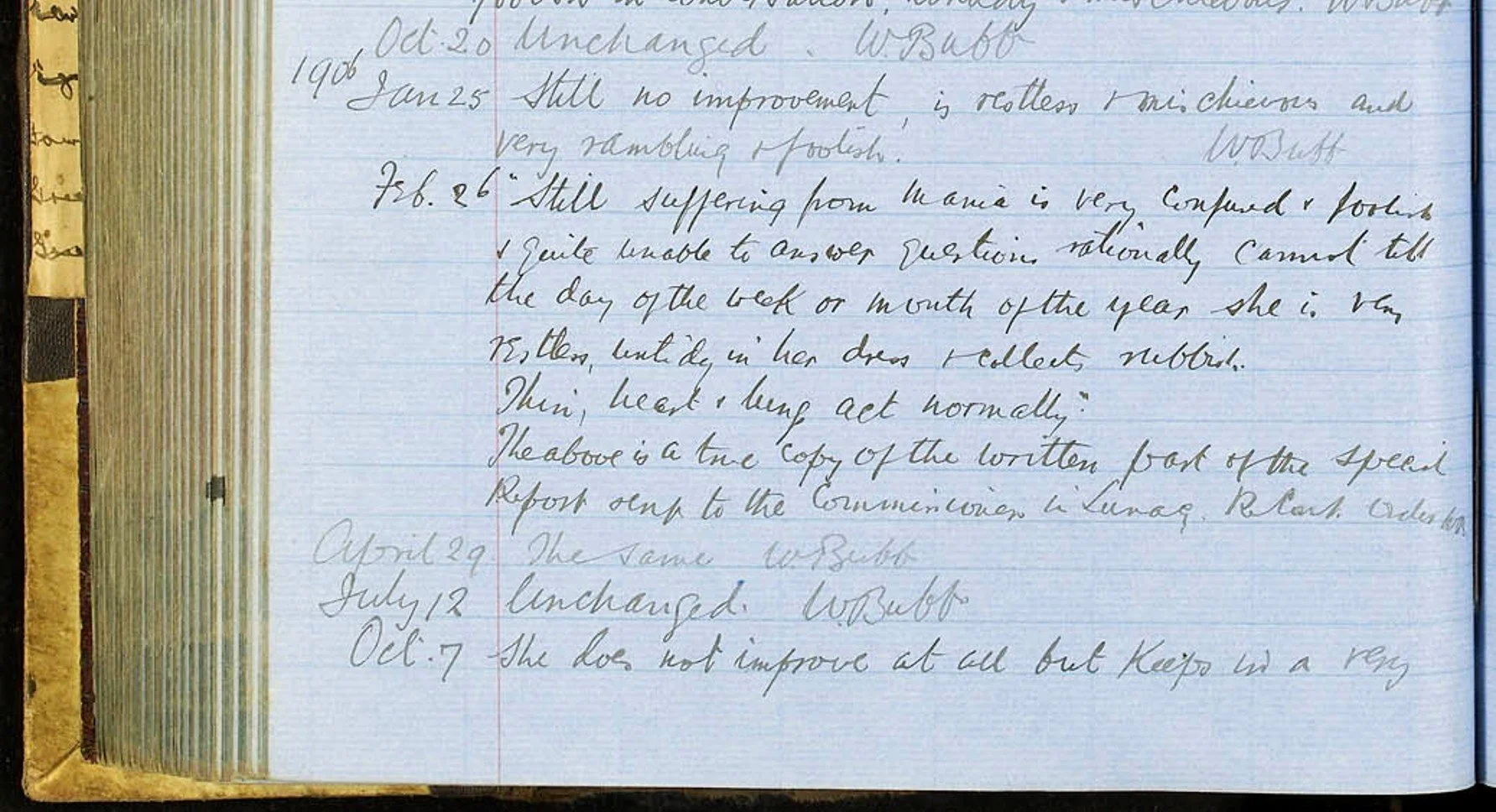
Seven months later Ada was admitted to the Powick Asylum for the third time, on 21 March 1904. The medical certificate states ‘She has been going wrong since her sister broke up her home & her brother threatened to turn her out .’ A week later, her medical notes read ‘Suffering from Mania, has a sullen taciturn manner, hardly ever speaks & if pressed to answer, only does so in monosyllables, displays little interest in anything, is perverted in her habits & at times is irritable & resistive.’
For the rest of this stint in the Asylum, time after time the notes state ‘No improvement’ or ‘Unchanged’. Despite the fact that she was described on admission as ‘pale & anaemic’, there is no mention in these notes of any medical treatment.
On 19 July 1907, Ada was transferred to Barnsley Hall Asylum, which had just opened in Bromsgrove. She was to spend the rest of her life there – actually, almost twice the amount of time she spent at Powick. But unfortunately, we know nothing of this, the last decade of her life. The records from this time are sealed under the Hundred Year Rule.
Ada died on 28 April 1917, of acute hepatitis and chronic renal cirrhosis. She was buried in Lodge Hill Cemetery in Birmingham.
There is one mystery about Ada’s life. The admission notes for her first stint at Powick state that she had a child. However, there is no record of a child born before 1899 with a mother of her name, or some variation of the spelling. There is a record of an Ada Florence Bodycote, born in 1897, but her parents on the baptism certificate are named as Arthur and Ann Maria Bodycote. This was Ada’s brother. Is it possible that this girl was Ada’s child, given to her brother to raise when she was incarcerated in the Asylum? Like much of Ada’s life, we will never know.
Research by Cathy Broad, 2026.
To view Ada’s patient records, click here.
With thanks to Cathy Broad, view a transcript of the records. Click here to download the file.
Go back to find out about more people who were patients at the asylum.