Powick Mental Hospital Between 1920 and 1950. Guest blog by Dr. Frank Crompton

In a conversation with a friend who works in a large mental hospital in Cambridge I was told that patients suffering from epilepsy were not admitted to mental institutions. Rather, they are treated in mental hospitals that specialise in their treatment. I found this interesting, because I have lists of several thousands of patients at the Worcester City and County Pauper Lunatic Asylum (later Powick Mental Hospital) and from 1852 until 1920, the institution operated using what was termed ‘Moral Treatment’.

In 1908 Dr. Henry Felix Fenton was appointed as a Medical Officer at this hospital. In the next 12 years he applied the Moral Treatment approach, and in this time he was promoted. In late 1916, he became a Senior Medical Officer in the institution, and in 1919 he was appointed as Medical Superintendent.  

In the 1870s, whilst working at Powick Asylum, Dr. Fenton came in contact with Dr. Robert Chivers Graves, who had fleetingly been Director of the new Herefordshire Asylum when it first opened at Burghill, 1872. After this Dr. Graves became an important influence over Dr. Fenton. Indeed, this influence led him to completely disregard the twelve years experience he had treating patients at Powick using ‘Moral Treatment’, and instead, he used Graves new approach called ‘Focal Sepsis’. Graves became medical superintendent of the Rubery Hill and Hollymoor Hospitals, Birmingham, and he used this new approach to treat patients there. The approach was based on the idea that mental illness was a reaction to localised infections or illness elsewhere in the body, and Dr. Fenton became convinced that this, rather than ‘Moral Treatment’ should be the basis of the treatment he used at the institution at Powick.

Thus when he became Director of the Powick Mental Hospital in 1920, Dr. Fenton applied ‘Focal Sepsis’ to the treatment of patients. 30 years later, Dr Ronald Sandison, Deputy Chief Medical Officer under Dr. Arthur Spencer, was extremely critical of what he referred to as ‘The Dead Hand of Fentonism’, his description of the treatment of ‘Focal Sepsis’ which he believed left the hospital and patients in a pitiable state. And, according to Andrew Scull who interviewed Graves, Dr. Henry Fenton was an ‘insignificant individual, who did everything he was told to do’. Essentially it appears Powick Mental Hospital had been amalgamated with the Birmingham Institutions administered by Dr. Graves.  

The ‘Focal Sepsis’ approach to treatment used by Dr. Graves was used in the treatment of mental illness between 1920 and the mid-1940s when Dr. Graves retired. At this time the treatment was regarded as suspect and ceased to be used. However, Dr., Fenton continued to use the approach, until he retired in 1948. It was this that Dr. Sandison particularly objected to and it appears that this is the reason there are no patients’ notes available for Powick Mental Hospital between 1920 and 1948. One presumes that these notes existed, but were disposed of because of their reliance on a suspect ideology.  

Frank Crompton. April 2025
1. OUTSIDE THE ASYLUM - GUEST BLOG BY MADDIE HALE

I am currently in the second year of my PhD in History at the University of Worcester, working on my thesis about the experiences of Japanese American women during the Second World War. I worked with the George Marshall Medical Museum in 2020 as part of a work experience module, during which I researched patients from Powick Lunatic Asylum. This research inspired me to write my undergraduate dissertation on the changing representation of female patients in the case books and patient registers during the latter half of the nineteenth century.

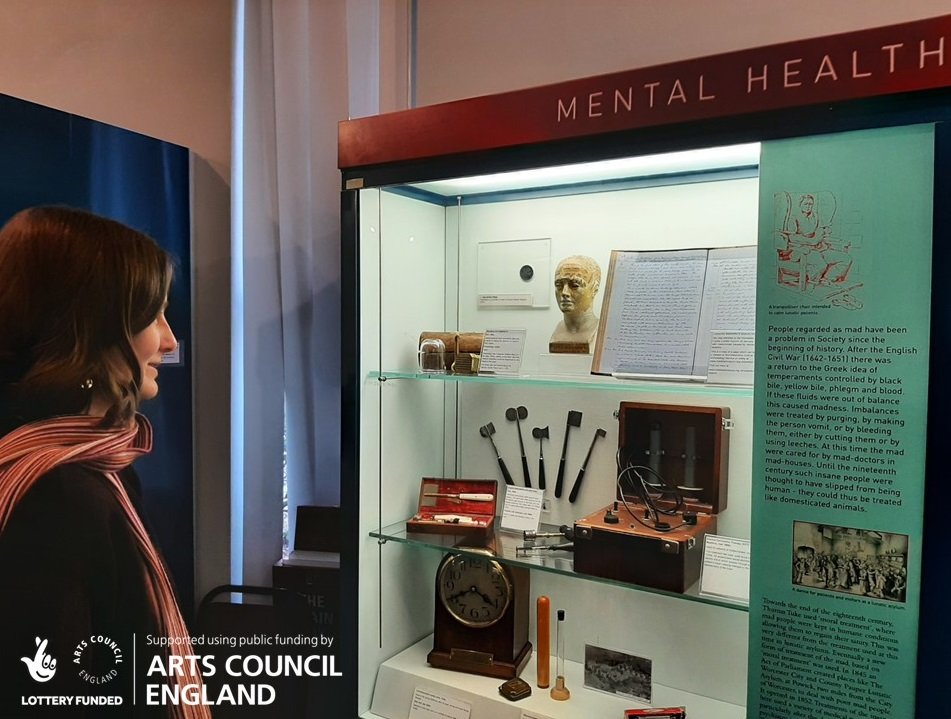
I am delighted to be back at the GMMM again, this time working as a research assistant on the Outside the Asylum project, supported using public funding by the National Lottery through Arts Council England. When I completed my work experience project back in 2020, it was during lockdown, and I wasn’t able to come in to the museum, so it’s really lovely to be here in person. As part of the project, I am researching the lives of patients outside of the asylum, which involves looking at censuses, birth and death registers, marriage records, and much, much more! I will also be looking through the museum collection to find items related to mental health, and how they were used at the asylum.

Unfortunately, a lot of the case notes are very impersonal and don’t give a lot of background to the patients, and so the aim of this project is to find out more about their lives before and after their time at Powick. A number of patients have been researched already (as well as a few members of staff) and are available to view on the George Marshall Medical Museum website. In the last few weeks, I have been focusing on researching the patients, and I have found it incredibly rewarding. I feel very lucky to be able to return to this research; I loved doing it for my dissertation, and I’m very glad that the museum has been given funding to carry out this research and make it available to museum visitors, whether in person, or online.

I have already found lots of fascinating things, and will be sharing some fun finds in further blog posts!

Maddie Hale, 2025

Summary of patients at the City and County of Worcester Pauper Lunatic Asylum: Guest blog by Dr. Frank Crompton

Powick Mental Hospital opened on 12th August 1852, as the City and County of Worcester Pauper Lunatic Asylum. It changed its name to Powick Mental Hospital in 1890, following the Mental Health Act of that year (4 & 5 Wil. IV. c. 76). It existed for the next 68 years, until 1920 when Dr. Henry Felix Fenton became Medical Superintendent. He altered the approach to the treatment of Mental Illness and we have little information on the period from 1920 to 1948. 

Between 1852 and 1920 the asylum treated 9,015 patients, 46.8% of them female. 2,054 patients, 56.9% of the males were treated for Dementia. 140 males were treated for what was then called Idiocy, and 124 for Imbecility, the number of women treated for these conditions was 79 and 95 respectively. 2,495 males and 1,126 females were treated for Mania. 649 males were treated for Melancholia, and 841 females for the same condition. There were 112 males and 83 females treated for Monomania, and 73 males and 102 females were treated for other causes.

By Dr. Frank Crompton

Recurring male admissions to Powick asylum between 1852-1920 - Guest Blog by Dr. Frank Crompton

An effort was made to identify how many male patients had entered the Powick Asylum* between 1 and 8 times between 1852 to 1920. Dr. Henry Felix Fenton had worked at the asylum from 1908 and became its Medical Superintendent in 1920. According to Ronald Sandison (Assistant Medical Superintendent in the 1950s), this period was under the ‘Dead Hand of Fentonism’, and Fenton destroyed what had been a highly successful mental institution for almost 70 years. Between 1920 and 1949 there are no records available in the archive so research the author of this Blog conducts is impossible to recreate after 1920.

Between 1852 and 1920 there had been 4797 male patients at the Powick Asylum. Of these patients 1880 had been in the institution on two occasions. There were then 90 other patients who had been in between 3 and 8 occasions. In these cases:

  • 57 were there on 3 occasions

  • 15 were there on 4 occasions

  • 8 were there on 5 occasions

  • 5 were there on 6 occasions

  • 4 were there on 7 occasions, and

  • 1 was there on 8 occasion.

There were thus 2827 male patients who made solitary visits to the asylum

*The institution had been the Worcester City and County Pauper Lunatic Asylum until 1890, and became Powick Mental Hospital from 1920.